Discover Guilin and Yangshuo
Reed Flute Cave
芦笛岩
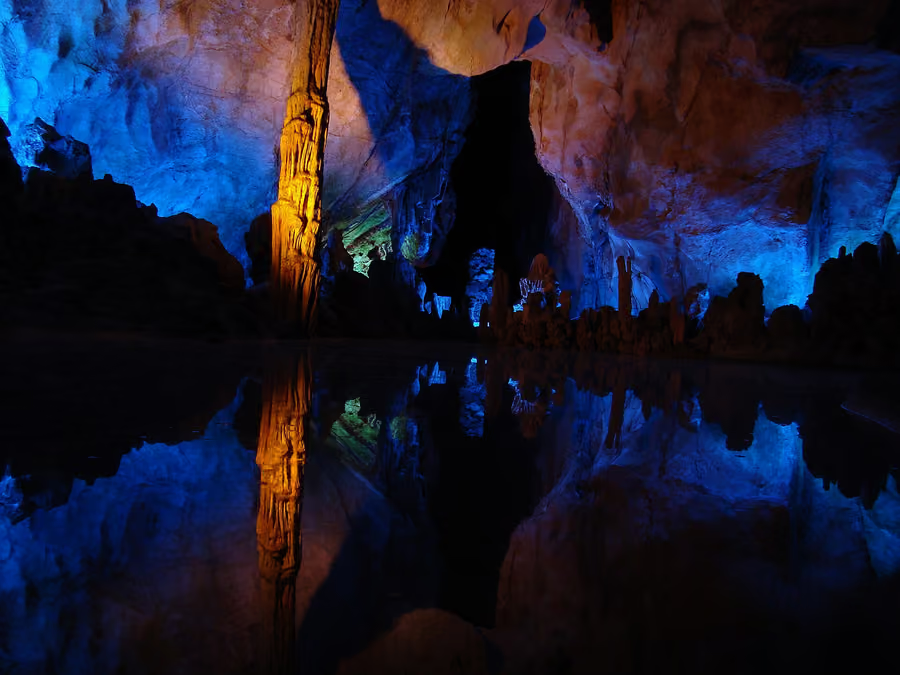
A 240-metre limestone cave lit in saturated colour, used since the 1960s to host visiting heads of state - hence its nickname, the Palace of Natural Arts. The Crystal Palace chamber with its mirror-still pool is genuinely startling.
The story
What makes this place special
Reed Flute Cave is a limestone cave about 240 metres long in a hill on the north-west edge of Guilin, named for the reed outside it that was cut into flutes. It is not a modern discovery in the sense that people often assume: more than seventy poems and travel notes are written in ink on the cave walls, the oldest dated to 792 AD in the Tang dynasty, so it was a visited place over a thousand years ago. It was then largely forgotten, and was rediscovered in the 1940s by refugees sheltering from Japanese troops.
What you’ll discover
A one-way walk-through of about 240 metres on a paved path, past stalactites and stalagmites that have all been given names and stories - Fish Tail Peak, Dragon Pagoda, a huge stalactite said to be the Dragon King's spear that Sun Wukong borrowed in Journey to the West - and ending at the Crystal Palace, a large chamber with a still lake that reflects the formations. The whole thing is lit in saturated multicoloured floodlighting, which is the defining feature of the visit and the main thing visitors have an opinion about. The Tang ink inscriptions are on the walls and are easy to miss entirely.
A little local insight
Good to know before you go
- Know what you are buying. The lighting is intense coloured floodlight, not natural cave presentation, and the formations are presented as a named-shape story. Visitors who want geology leave annoyed; visitors who treat it as a lit spectacle enjoy it.
- Ask where the ink inscriptions are. Over seventy Tang-and-later wall writings are the genuinely rare thing here and no part of the standard route draws attention to them.
- The walk-through is short - well under an hour - so do not build a half-day around it. It pairs naturally with Seven Star Park or Elephant Trunk Hill on the same side of Guilin.
- If you are also going to Yinzi Cave near Yangshuo, do one cave, not both. They are the same experience and Yinzi is generally the better-regarded of the two.
- It is cool and damp inside year round, which makes it a good midday choice in Guilin's summer heat, and worth a layer in winter.
When to come
Any time of day - it is entirely artificially lit, so weather and light outside are irrelevant, which makes it the right thing to do on a wet or blisteringly hot afternoon when the karst views are a write-off. Go against the tour-group flow: mid-morning and mid-afternoon coach waves are heaviest.
Getting around
Partly manageable but not fully. The through-route is a built, railed, paved path rather than natural cave floor, which is a good start, but it includes flights of steps and some narrow and low sections, and it is one-way so you cannot easily turn back. Surfaces are permanently wet and slippery. A bad knee can do it slowly; a wheelchair generally cannot complete the circuit. There is also a climb from the ticket gate up to the cave mouth. Check with staff on the day before committing.
Worth knowing before you go
The coloured floodlighting is not subtle, and photos come out better than you expect. Visit in the middle of a hot day - the cave stays about 20C year round.
Compare established providers
Check live tours and tickets
Search for Reed Flute Cave in Guilin and Yangshuo. Prices, availability, payment and confirmation are handled by the booking provider.
China Travel Select does not take payment or create the reservation. Confirm the exact name, dates, inclusions and cancellation rules on the provider’s page.
Take a closer look
Maps, videos & more
Prices and hours change. These are the places to check on the day.