Skip to content
A little preparation. A much better adventure.Independent travel advice · Made for China

Why China

A whole world of reasons to go.

Ancient cities, mountain landscapes, memorable meals, and a journey that can be easier than you imagine. Explore the possibilities, with practical advice and sources to help you decide.

The main reasons to go

The short version

China spent twenty years building the best domestic travel infrastructure in the world, and then — between 2023 and 2026 — opened it to visitors who had largely stopped coming. 80 nationalities can now enter without a visa at all, 57 more can transit for up to 240 hours, and the payment apps that run daily life finally accept foreign cards.

The result is a country that is far easier to travel than its reputation, considerably cheaper than Japan or Western Europe, and still largely free of other foreign tourists. That window is the argument for going now rather than later.

31

destinations covered here

389

places to see, each with a page

269

local dishes, and 320 places to eat them

A country made for exploring

This is the part that surprises people most, and it is the part that makes everything else possible.

China's high-speed rail network reached 50,400 km of operating line by the end of 2025, having grown from 37,900 km in 2021.

50,400 km

This is the largest high-speed network on earth by a wide margin and it is still being extended by roughly 2,000 km a year. For a visitor it means almost every city worth a stop is reachable by a fast, frequent train rather than a flight.

As of end of 2025.High-speed rail's rapid rise rolls on (China Daily, 5 Jan 2026)China's railway network sets new records in 2025 (China Daily, 4 Jan 2026)· Read in reporting, not from the issuing body

China's total railway network, high-speed and conventional combined, reached 165,000 km at the end of 2025.

165,000 km

The conventional network matters as much as the high-speed one for travellers: overnight sleepers still serve Tibet, Xinjiang and much of the southwest where high-speed track has not yet reached.

As of end of 2025.China's railway mileage tops 165,000 km (6 Mar 2026)· Read in reporting, not from the issuing body

China's urban rail transit network reached about 13,000 km of operating line across mainland cities by the end of 2025, after adding nearly 911 km in that year alone.

13,000 km

Metro coverage is the single biggest reason a visitor does not need a car or a driver. In the cities most tourists visit, signage and announcements are bilingual and ticket machines have an English mode.

As of end of 2025.Jinan tops national rail transit growth in 2025 (China Daily, 13 Jan 2026, citing China Association of Metros)

China had 270 certified transport airports at the end of 2025, 266 of them with regular scheduled flights, up from 241 at the end of 2020.

270

Twenty-nine new airports opened in five years, mostly in second- and third-tier cities and in the west. For a traveller this means places like Lhasa, Kashgar, Jiuzhaigou and Zhangjiajie are reachable without a multi-day overland leg.

As of end of 2025.China's civil aviation market sees record passenger, cargo numbers in 2025 (People's Daily Online / Xinhua, 27 Feb 2026)Civil aviation soars and aims to go higher in 2026 (China Daily, 7 Jan 2026)

China's international air network connected 263 cities in 90 countries as of the end of 2025, with international flights recovered to over 90% of pre-pandemic levels.

263 cities, 90 countries

The recovery of long-haul capacity is recent. International passenger traffic rose 21.6% in 2025 over 2024, which has brought fares down from their post-pandemic peak.

As of end of 2025.Civil aviation soars and aims to go higher in 2026 (China Daily, 7 Jan 2026)

Chinese high-speed trains operate commercially at 350 km/h, the fastest scheduled rail speed in the world.

350 km/h

350 km/h service returned on the Beijing-Shanghai line on 21 September 2017 and is now standard on trunk routes. The line itself was designed for 380 km/h, and a next-generation CR450 trainset is in testing for higher speeds.

As of 2017 onwards.Beijing-Shanghai high-speed railway (Wikipedia)

Beijing to Shanghai is 1,318 km and the fastest scheduled trains cover it in about 4 hours 28 minutes.

4h 28m / 1,318 km

That is roughly the London-to-Edinburgh distance doubled, done in an afternoon, city centre to city centre, with no airport security queue. Most services on the route take 4h30m to 4h48m, so the slower ones are barely slower.

As of 2026.Beijing-Shanghai high-speed railway (Wikipedia)

The Beijing Subway runs 30 lines over about 909 km and became the world's longest metro system by route length in December 2023.

909 km, 30 lines

It carried around 9.46 million passengers a day in 2023. For a visitor the practical consequence is that nearly every major sight in Beijing has a metro stop within walking distance.

As of 2023-2024.Beijing Subway (Wikipedia)
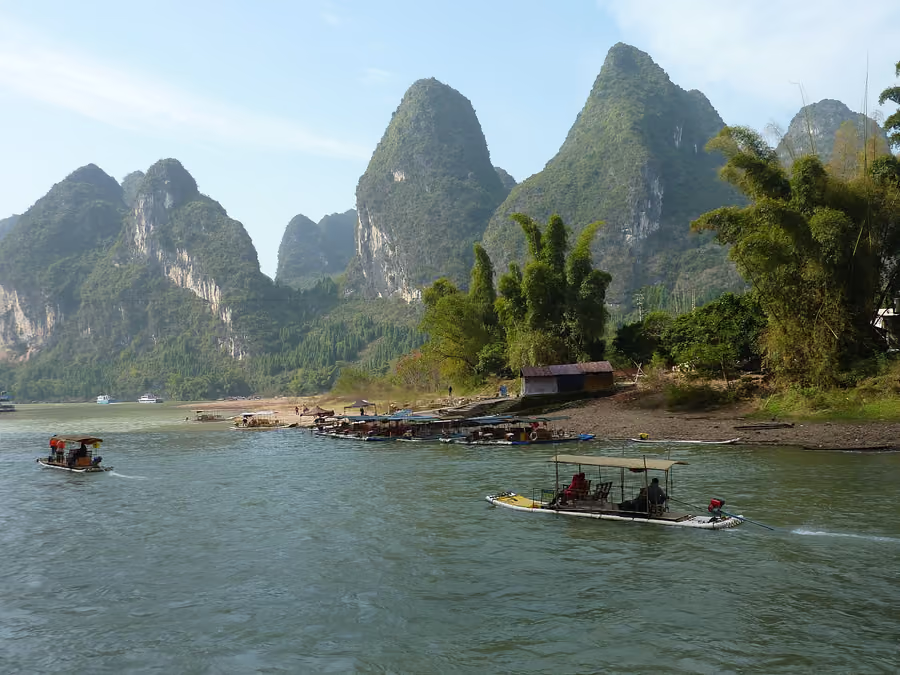
Guilin and Yangshuo, China
Photo: Huangdan2060 · CC0

What things actually cost

Not 'cheap' as a feeling. Here are the numbers, so you can judge against home.

A second-class seat from Beijing to Shanghai costs about 553 yuan, roughly 78 US dollars for 1,318 km.

¥553

That works out to about 6 US cents per kilometre on the country's flagship route. Second-class is a 3+2 airline-style seat with a tray table and power socket, not a budget option. Business class on the same train is about 1,748 yuan.

As of 2025-2026.Shanghai-Beijing railway to adopt floating price system (China Daily, 24 Oct 2020)· Read in reporting, not from the issuing body

Beijing Subway fares start at 3 yuan (about 42 US cents) for trips up to 6 km and rise by distance band to 7 yuan for 32-52 km.

¥3 (~US$0.42)

Shanghai uses the same 3-yuan starting fare, set in 2005, with 1 yuan added per 10 km beyond the first 6 km; the average Shanghai fare actually paid in 2025 was 4.23 yuan for an average 16.45 km trip. A whole day of city sightseeing by metro rarely exceeds 15 yuan.

As of 2025.Beijing Subway - fares (Wikipedia)Shanghai seeks public opinion on metro fare adjustment (Shanghai Municipal Government, 20 Aug 2026)· Read in reporting, not from the issuing body

A meal at an inexpensive restaurant in China typically costs 20 yuan (about 2.80 US dollars), with a usual range of 13 to 40 yuan.

¥20 (~US$2.80)

That is the price band a bowl of hand-pulled noodles, a plate of dumplings or a rice-and-two-dishes lunch sits in. Numbeo is user-submitted data, not official statistics - this figure comes from 1,099 contributors and 14,611 price entries over twelve months.

As of last updated 11 October 2026.Numbeo Cost of Living in China (user-submitted data, 1,099 contributors)

A three-course meal for two at a mid-range Chinese restaurant typically costs 150 yuan (about 21 US dollars), with a usual range of 100 to 300 yuan.

¥150 for two (~US$21)

Split between two people that is around 10 dollars a head for a proper sit-down dinner. A pint of local draft beer runs about 7 yuan. Again, this is Numbeo's crowd-sourced data, not an official price survey.

As of last updated 11 October 2026.Numbeo Cost of Living in China (user-submitted data, 1,099 contributors)

Consumer prices excluding rent are 54.9% higher in Japan than in China, with groceries 60.3% higher and restaurants 39.6% higher.

+54.9% (Japan vs China)

This is the comparison most readers want, because Japan is the default alternative for a first trip to East Asia. The caveat matters: Numbeo is crowd-sourced, drawn from 1,099 contributors for China and 473 for Japan over twelve months, and it measures resident cost of living rather than a tourist basket.

As of last updated 11 October 2026 (China), 8 October 2026 (Japan).Numbeo: Cost of Living Comparison Between China and Japan (user-submitted data)

A metered taxi in China typically starts at 10 yuan (about 1.40 US dollars), with a usual range of 8 to 14 yuan.

¥10 (~US$1.40)

Ride-hailing through DiDi is usually cheaper still and removes the language problem entirely, since the destination is entered in the app. DiDi's China app has offered an English interface since 2017 and its current listing advertises English-language registration with an overseas mobile number, in-app bilingual translation with the driver, international bank cards and 24/7 English support.

As of last updated 11 October 2026.Numbeo Cost of Living in China (user-submitted data, 1,099 contributors)Didi translates its app into English for visitors to China (PhocusWire)· Read in reporting, not from the issuing body

A different flavour in every region

Eight regional traditions that have almost nothing to do with the Chinese food you know.

Chinese cuisine is traditionally classified in expanding tiers: Four Great Traditions, then Eight, Ten, Twelve, Fourteen and even Sixteen.

8 (expanding to 16)

The Eight Great Traditions are Sichuan, Shandong, Cantonese, Jiangsu, Anhui, Fujian, Hunan and Zhejiang; the Ten add Beijing and Shanghai, the Twelve add Henan and Shaanxi, the Fourteen add Hubei and Liaoning. This is a cultural convention, not a government designation. The practical point for a traveller is that moving province to province changes the food completely - Xi'an, Chengdu and Guangzhou are three different cuisines, not three versions of one.

As of 2026.Chinese cuisine - regional traditions (Wikipedia)

The 2026 Michelin Guide for Shanghai, Jiangsu and Zhejiang covers 409 restaurants, of which 77 hold stars: one three-star, 14 two-star and 62 one-star.

409 restaurants, 77 starred

The breakdown by region is 156 restaurants in Shanghai, 111 in Jiangsu and 142 in Zhejiang, with coverage newly extended to Changzhou, Wenzhou and Taizhou. Taian Table remains Shanghai's only three-star restaurant.

As of edition released 9 April 2026.Shanghai leads 2026 Michelin Guide in Yangtze Delta selection (Shanghai Municipal Government, 14 Apr 2026)MICHELIN Guide Shanghai, Jiangsu & Zhejiang (Michelin corporate)· Read in reporting, not from the issuing body

Michelin's mainland China coverage now spans Beijing, Shanghai, Guangzhou, Shenzhen, Chengdu, Hangzhou and whole provinces including Fujian, Jiangsu and Zhejiang, with Hunan and Tianjin added for 2026.

Fujian was the first province-wide selection in mainland China: 69 restaurants across Fuzhou, Xiamen and Quanzhou, of which 47 are Bib Gourmand and only 5 hold a star. That ratio is the real story - the guide's weight in China sits at the cheap end.

As of 2026.Michelin Guide - regional coverage (Wikipedia)MICHELIN Guide Beijing 2026 (guide.michelin.com, 28 Oct 2025)· Read in reporting, not from the issuing body

Michelin's Bib Gourmand award requires a restaurant's menu to fall below a price ceiling set to local economic conditions, so in China it reaches genuinely cheap places.

Bib Gourmand has recognised "exceptionally good food at moderate prices" since 1997 and the threshold is set regionally - Michelin does not publish a mainland China figure, but for comparison the Paris ceiling was 45 euros in 2025. In practice Chinese Bib Gourmand entries include noodle shops and single-dish specialists where a meal costs tens of yuan.

As of 2026.Michelin Guide - Bib Gourmand (Wikipedia)

How safe it is, in the words of the people who assess it

We quote the travel advisories rather than paraphrase them upward.

The UK Foreign, Commonwealth & Development Office states that "Serious crime against foreign nationals is relatively rare, but incidents can happen."

That is the FCDO's own wording and it is deliberately measured, not a clean bill of health. The same page warns that petty theft on overnight trains is common, that scams operate in tourist areas, and that isolated violent attacks have affected foreign nationals.

As of 2026.FCDO foreign travel advice: China - Safety and security

On Numbeo's user-submitted crime index China scores 22.90 for crime and 77.10 for safety, with "walking alone at night" rated 72.95 (High).

77.10 safety index

Numbeo is crowd-sourced perception data, not police statistics: these scores come from 2,030 contributors and reflect how visitors and residents say they feel, not recorded offences. Treat it as a sentiment reading that happens to point the same way as the government advisories, not as evidence.

As of last updated 9 October 2026.Numbeo Crime Index - China (user-submitted data, 2,030 contributors)

Things that just work

A decade of domestic convenience that visitors could not use until very recently.

Since 2024 the People's Bank of China has required Alipay and Tenpay (WeChat Pay) to allow foreign visitors a single-transaction limit of 5,000 US dollars and an annual cumulative limit of 50,000 US dollars, up from 1,000 and 10,000.

US$5,000 per transaction / US$50,000 a year

This is the single biggest practical change for visitors in a decade. You link a Visa, Mastercard, JCB, Amex or Discover card to the app, verify with a passport photo, and then pay by QR code the way locals do - street stalls, metro gates, taxis, temple tickets. The same PBOC guidance told both platforms to simplify identity verification and speed up card binding.

As of announced March-April 2024, still the current framework.Payment service guide for overseas visitors to China (gov.cn / State Council, 11 Apr 2024)China's Ant Group increases transaction limits for overseas travelers (Fintech News Hong Kong)· Read in reporting, not from the issuing body

Meituan's daily on-demand delivery orders passed 115 million in the second quarter of 2025 and peaked above 150 million in July 2025.

115 million orders a day

Delivery is not a convenience of last resort in China, it is infrastructure: a visitor with Alipay or WeChat Pay can get food, medicine, a phone charger or bottled water to a hotel room in under thirty minutes, in most cities, at almost any hour. Both Meituan and Ele.me run as mini-programs inside Alipay and WeChat, so no separate account is needed.

As of Q2 2025; peak July 2025.Meituan Q2 2025 earnings call transcriptMeituan hits 120 million orders in a day (KrASIA)· Read in reporting, not from the issuing body

Shanghai and Chengdu have installed self-service luggage lockers across their metro networks, including at Shanghai Railway Station, Hongqiao Railway Station and Chengdu West Railway Station, with Chengdu covering 25 stations.

25 stations (Chengdu); ¥2-5 per hour

Shanghai's locker interface supports English, Japanese and Korean and tiered pricing runs from roughly 2 yuan an hour for a backpack to 5 yuan an hour for a 26-inch suitcase, capped daily, with a 24-hour maximum. The catch is that you unlock them by scanning a QR code in WeChat or Alipay, so the payment apps are a prerequisite rather than an optional extra.

As of 2025-2026.Shanghai expands luggage storage services across metro network (Shanghai Municipal Government, 23 Jul 2025)Chengdu Metro Expands Luggage Storage to 25 Stations· Read in reporting, not from the issuing body

Depth and scale

The sheer amount of it is hard to convey in a sentence, so here are some numbers.

China has 61 UNESCO World Heritage Sites, ranking second in the world behind Italy's 62.

61

The 61 break down as 42 cultural, 15 natural and 4 mixed. The mix matters: it is not only temples and walls but karst landscapes, fossil beds and the Tibetan plateau's headwaters, so a heritage-led itinerary can be a landscape itinerary too.

As of 2026.List of World Heritage Sites in China (Wikipedia, citing UNESCO)UNESCO World Heritage Centre - China (States Parties)· Read in reporting, not from the issuing body

China had 7,188 registered museums at the end of 2025 and they received 1.56 billion visits that year; over 91% of museums offer free admission.

7,188 museums, 1.56bn visits

The free-entry policy is the detail that surprises visitors most: the Shanghai Museum, the National Museum of China, the Shaanxi History Museum and most provincial museums charge nothing, though they require advance online booking and the best ones sell out days ahead. The 91.46% free-admission figure is end-2024 data.

As of end of 2025 (free-admission share: end of 2024).China's museums receive 1.56 billion visits in 2025 (Xinhua, 18 May 2026)China's museum sector sees rapid growth (26 May 2025)· Read in reporting, not from the issuing body

China designates 359 National 5A tourist attractions, the top tier of its official scenic-area rating system.

359

5A status is awarded by the Ministry of Culture and Tourism against criteria covering transport access, safety, cleanliness, uniqueness and recognition, and it can be revoked. For a visitor the rating is a reliable proxy for 'this site has English signage, proper toilets and a working ticket system' rather than a judgement of beauty.

As of 2025.AAAAA Tourist Attractions of China (Wikipedia)People's Daily / China Daily, China Tourism Day, 20 May 2025 (figure of 358)· Read in reporting, not from the issuing body

The size of the place

Everything here is further apart than it looks on a map.

China's national railways carried 4.255 billion passenger trips in 2025, with a single-day peak above 23.13 million trips.

4.255 billion

The sheer throughput is why trains run every few minutes on trunk routes like Beijing-Shanghai. It also explains why seats sell out around public holidays: the system runs near capacity at peaks.

As of 2025.China's railway network sets new records in 2025 (China Daily, 4 Jan 2026)· Read in reporting, not from the issuing body

China covers 9,596,960 square kilometres, of which 33% is mountains, 26% plateau, 19% basins, 12% lowland plains and 10% hills.

9,596,960 km²

Climate runs from tropical in the south to subarctic in the north. In practical terms you can be on a Hainan beach and in sub-zero Heilongjiang forest in the same country, which is why no single season is 'the' time to visit - it depends entirely on which China you want.

As of 2026.Geography of China (Wikipedia)

China recorded 888 million domestic tourist trips during the 1-8 October 2025 National Day holiday, up 15.9% year on year, with 809 billion yuan of tourism spending.

888 million trips

This is the number to plan around rather than admire. A record 23.13 million people travelled by train on 1 October 2025 alone. If your dates are flexible, avoiding the first week of October and the Spring Festival period transforms the experience at major sights.

As of 1-8 October 2025.Over 2.4b cross-regional trips expected during Golden Week (8 Oct 2025)China's railway network sets new records in 2025 (China Daily, 4 Jan 2026)· Read in reporting, not from the issuing body

Worth sorting before you fly

Nothing here should put you off, and almost all of it is handled in an afternoon at home. We list it because knowing about the Great Firewall now is a far better morning than discovering it in Beijing — and because a page that only sells is the easiest kind to disbelieve.

Air quality is far better than China's 2013 reputation, but it is not clean: the national average PM2.5 in 2025 was 28 micrograms per cubic metre, well above the WHO guideline of 5.

The national share of days rated good air quality reached 89.3% in 2025. Winter in the north is still the weak spot, and a bad January day in Beijing, Xi'an or Harbin can be genuinely unpleasant for anyone with asthma. Check a live AQI app rather than assuming either extreme.

China reports improved ecological environment in 2025 (Xinhua via gov.cn, 16 Jan 2026)

Petty theft on overnight trains is common, according to the FCDO.

The FCDO advises searching your compartment and locking the cabin door before the train leaves. It also warns about the "tea tasting" and "massage" scams in tourist areas, which can escalate to "threats, violence or credit card fraud".

FCDO foreign travel advice: China - Safety and security

The FCDO states that "Women, travelling alone or with female friends, could be at higher risk."

Its wording on the underlying risk is that "Personal attacks and sexual assaults are rare, but they can happen, including through drinks being spiked." It specifically warns against unmarked or unmetered taxis, citing "incidents of sexual assault and robbery against foreign nationals" - which is a practical argument for using a ride-hailing app with a logged trip record instead of hailing on the street.

FCDO foreign travel advice: China - Safety and security

Two periods are genuinely best avoided: the National Day holiday in the first week of October and the 40-day Spring Festival travel rush.

The 2026 Spring Festival rush ran 2 February to 13 March, with a projected 9.5 billion inter-regional trips and a single recorded day of 352,999,000 trips on 20 February. Trains and flights sell out weeks ahead, hotel rates spike, and famous sites operate timed-entry queues. Travel in late spring, autumn outside the October holiday, or winter outside Spring Festival and the same places are manageable.

China sees record daily passenger flow in Spring Festival travel rush (22 Feb 2026)Over 2.4b cross-regional trips expected during Golden Week (8 Oct 2025)

Tibet requires a permit and an organised tour, the FCDO warns separately about Xinjiang and the China-Myanmar border, and Australia's overall advice for China is "Exercise a high degree of caution".

The FCDO states: "You must get a permit to travel to Tibet and the Tibet Autonomous Region (TAR) through a specialist travel agent in China. You must also travel on an organised tour", and notes permits "can be stopped without notice". On Xinjiang it states that "Violent unrest in Xinjiang has resulted in deaths" and that "There have been widespread arbitrary arrests and extra-judicial detentions in Xinjiang". On the China-Myanmar border it states the violence "has occasionally spilled over into China". These are the advisories' own words, stated without amplification or softening. Note also what the advisories spend their length on: not street crime but arbitrary detention, exit bans, broad national security laws and the risks of political expression. That is a different risk profile from most destinations, and worth reading in full for your own nationality before booking.

FCDO foreign travel advice: China - Regional risksSmartraveller: China (Australian Government)

Google, YouTube, Facebook, Instagram, WhatsApp, X, Wikipedia, Reddit and Telegram are all blocked in mainland China, along with the BBC, Reuters, the New York Times and the Guardian.

The block dates are long-standing: Facebook since July 2009, Instagram since September 2014, WhatsApp since September 2017, Wikipedia in all languages since 23 April 2019. A VPN is the standard workaround but it must be installed and tested before arrival, because VPN providers' own websites are also blocked once you are in the country. Chinese alternatives genuinely work - Amap and Baidu Maps for navigation, WeChat for messaging - but you will not reach your own email or messaging apps without a VPN.

List of websites blocked in mainland China (Wikipedia)

China ranks 86th on the EF English Proficiency Index 2025 with a score of 464, placing it in the index's 'Low' band, below the global average of 488.

The spread inside China is the useful part: Hangzhou scores 515 and Beijing 514, while Zhengzhou scores 439. In practice that means staff at tier-1 city hotels, airports and major museums will usually have some English, and almost nobody in a smaller city restaurant or taxi will. The index is based on self-selected test takers, not a random sample, so treat it as directional. A translation app that works offline is the single most useful thing to install before you fly.

EF English Proficiency Index - ChinaEF English Proficiency Index (Wikipedia, band thresholds)

You must register your place of residence with the local Public Security Bureau within 24 hours of arrival, and your passport is the key to almost every booking.

The FCDO states: "You must register your place of residence with the local Public Security Bureau within 24 hours of arrival", adding that "If you're staying in a hotel, they will register you when you check in" - so hotel guests are covered automatically, but anyone in an apartment or a friend's home must do it themselves. It also notes that authorities run "regular spot-checks" on foreign nationals' documents. Separately, train tickets, museum entry and many attractions use real-name booking tied to your passport number, which means carrying the physical passport rather than a copy and booking ahead rather than turning up.

FCDO foreign travel advice: China - Entry requirements

We have written guides for most of these. The survival kit handles the language problem offline, and the readiness checker tells you what to set up before you fly rather than after you land.

Where to start

Three of the 31 places on this site, chosen to show how different they are from one another.

Guilin and Yangshuo, China
Huangdan2060 · CC0

Guilin and Yangshuo

The karst landscape on the ¥20 note

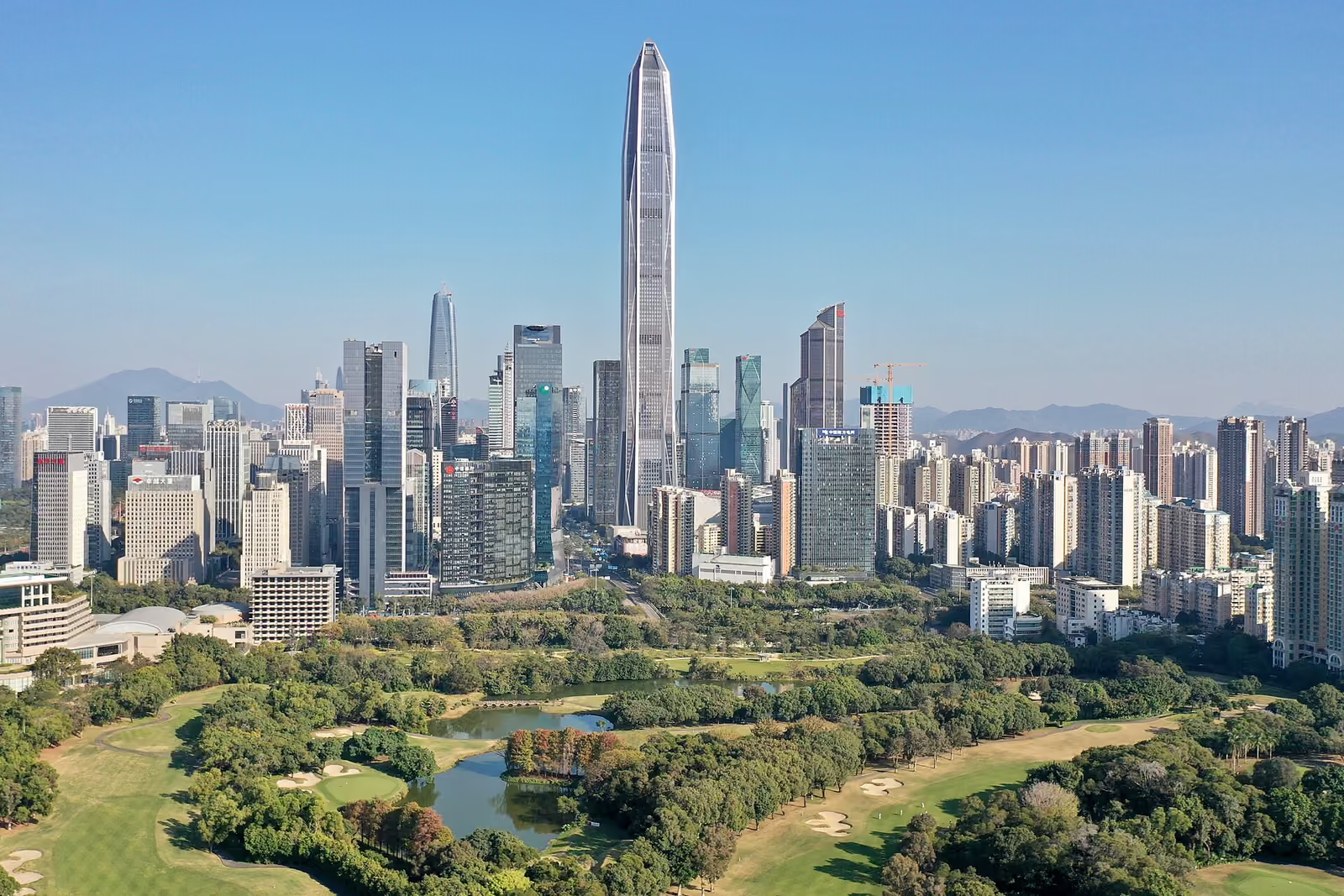
Shenzhen, China
Charlie fong · CC BY-SA 4.0

Shenzhen

A city built in forty years, and free to look at

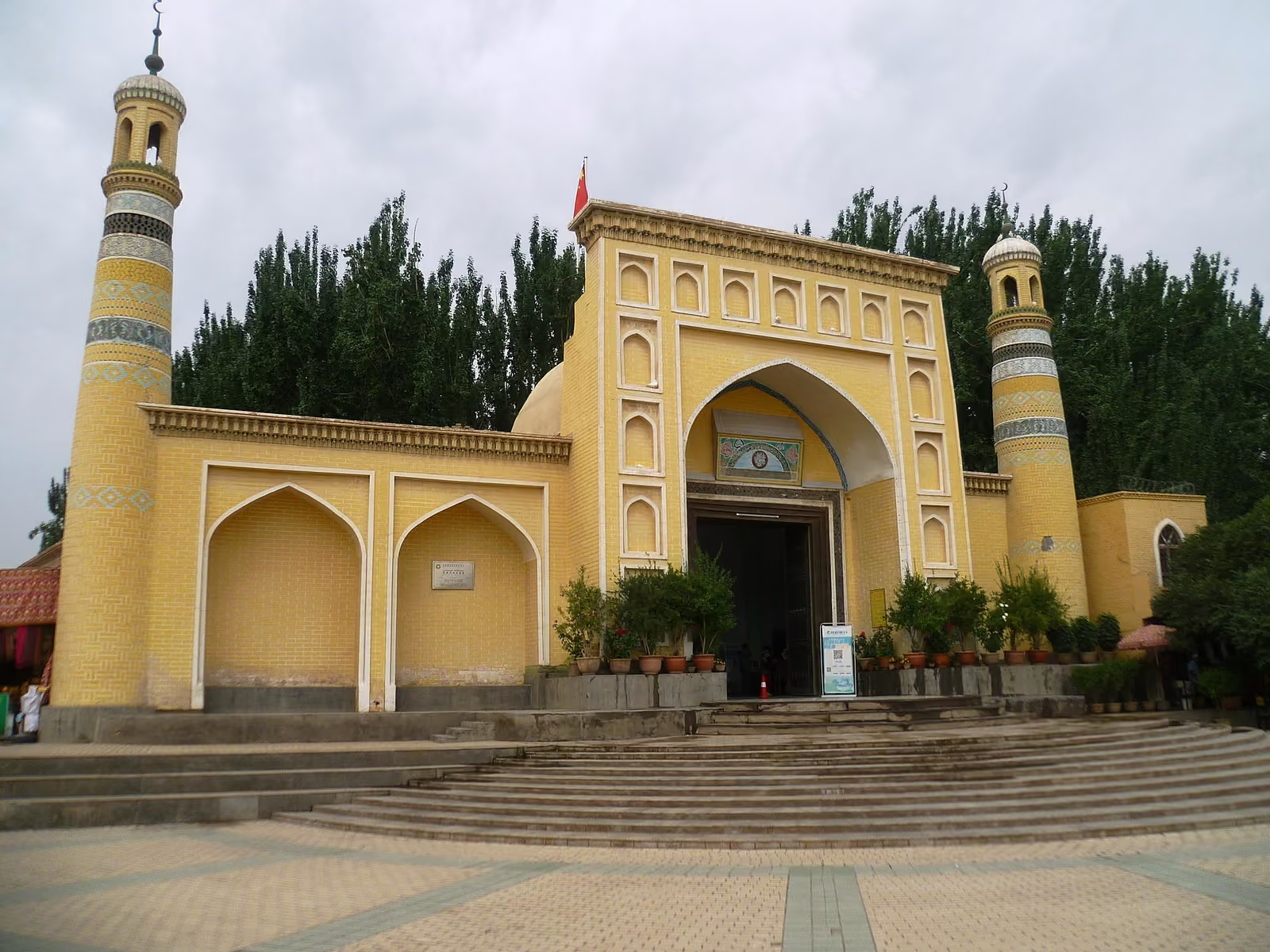
Xinjiang, China
Radosław Botev · CC BY 3.0 pl

Xinjiang

Kashgar, Turpan and the Tianshan — and a lot of checkpoints

All 31 destinations →

Why you can check all of this

Every figure above links to where it came from, and says what year it is from. Entry rules in particular have changed roughly quarterly for two years, so anything written before 2026 about Chinese visas is probably wrong — including, eventually, this. The date at the bottom of each page tells you what you are trusting.

How this site verifies things →