Discover Kunming
Golden Temple (Jindian)
金殿风景名胜区
A Taoist hall cast entirely in bronze in 1671 and still standing in a camellia-planted park on Mingfeng Hill. It is one of the largest surviving bronze buildings in China, and over a thousand camellia varieties flower here from January to March.
The story
What makes this place special
The Golden Temple, properly Taihe Palace, stands on Mingfeng Hill northeast of Kunming. It was first built in 1602 by Chen Yongbin, the Ming grand coordinator of Yunnan, consciously copying the Taihe Palace and bronze hall of Mount Wudang in Hubei, dedicated to the Daoist deity Zhenwu and enclosed by a brick wall with gate towers. The present bronze hall is attributed to a rebuilding by Wu Sangui, the Qing prince of Yunnan, with sources giving 1670 or 1671 on the basis of its inscriptions. It stands on a marble terrace, weighs over 200 tonnes, measures 6.7m high and 7.8m in each horizontal direction, and is described as the largest bronze hall in China and the best preserved of the country's four. The site holds a bronze bell cast in 1423 and a sword attributed to Wu Sangui, and is a national-level protected monument.
What you’ll discover
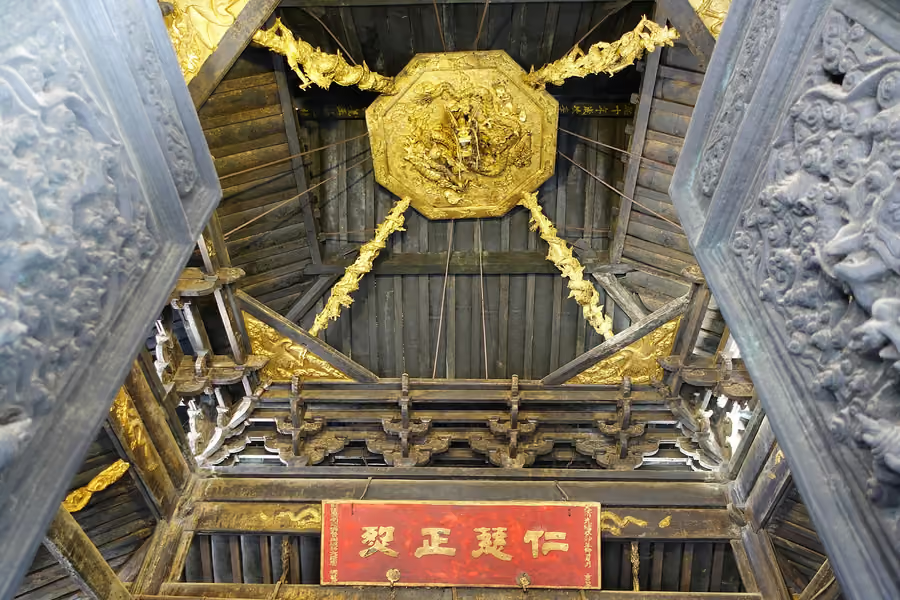
A wooded hill with three successive gateways on the climb, then a walled compound with the bronze hall at its centre: an entirely metal building, columns, beams, brackets, doors and roof tiles all cast in bronze, dark with age and fine in detail, which is strange to stand in front of because it looks like timber architecture until you touch it. Behind it a tall bell tower holds the Ming bronze bell, and the surrounding park includes a large camellia garden that flowers in late winter and early spring.
A little local insight
Good to know before you go
- Walk round the back of the hall and look up under the eaves. The cast bracket sets and tile ends are where the craftsmanship is, and almost everyone photographs only the front.
- The camellia garden inside the park is the local reason to come: around a hundred mu of camellias flower in late winter and early spring, and Kunming residents arrive for the flowers rather than the temple.
- Climb the bell tower. It is a steep internal staircase, but the 1423 bell and the view over the hill from the top are the better half of the site.
- It is on the edge of the old Horti-Expo Garden, and the two share a hillside, so they combine into one half day by metro and a short ride.
- Avoid Chinese New Year and the first lunar month, when this is a major Daoist worship site and the compound is impassable with incense and crowds.
When to come
Late winter to early spring, February and March, for the camellias and clear air. Mornings are quiet. Any dry day works; the hill is pleasant and shaded in summer.
Getting around
Mixed. The hilltop compound is reached by a series of stepped gateway climbs, and although a road and internal shuttle get vehicles part way up, the final approach to the bronze hall involves steps. The compound and camellia garden are then largely flat. The bell tower is internal stairs only. A bad knee can manage with the shuttle; a wheelchair user should ask at the entrance about vehicle access to the upper level.
Worth knowing before you go
Time this for the camellia season between January and March, when Kunming's "eternal spring" climate actually shows itself and the park is at its best.
Compare established providers
Check live tours and tickets
Search for Golden Temple (Jindian) in Kunming. Prices, availability, payment and confirmation are handled by the booking provider.
China Travel Select does not take payment or create the reservation. Confirm the exact name, dates, inclusions and cancellation rules on the provider’s page.
Take a closer look
Maps, videos & more
Prices and hours change. These are the places to check on the day.