Discover Nanjing
Presidential Palace
总统府
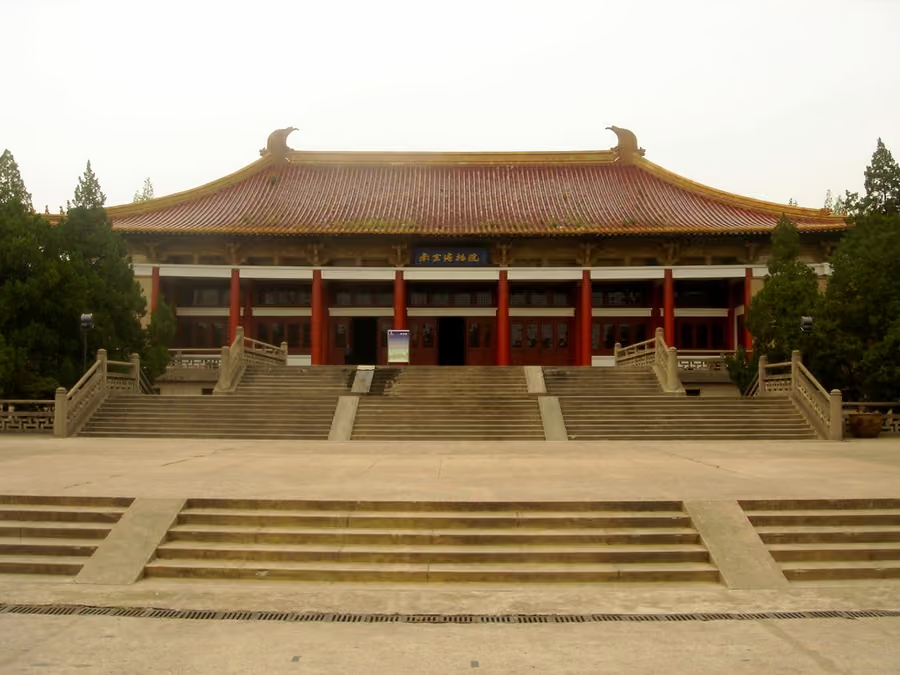
A single walled compound that was a Ming princely mansion, the Taiping rebels' heavenly palace, Sun Yat-sen's provisional presidency and then Chiang Kai-shek's seat of government. Republican-era China in one visit.
The story
What makes this place special
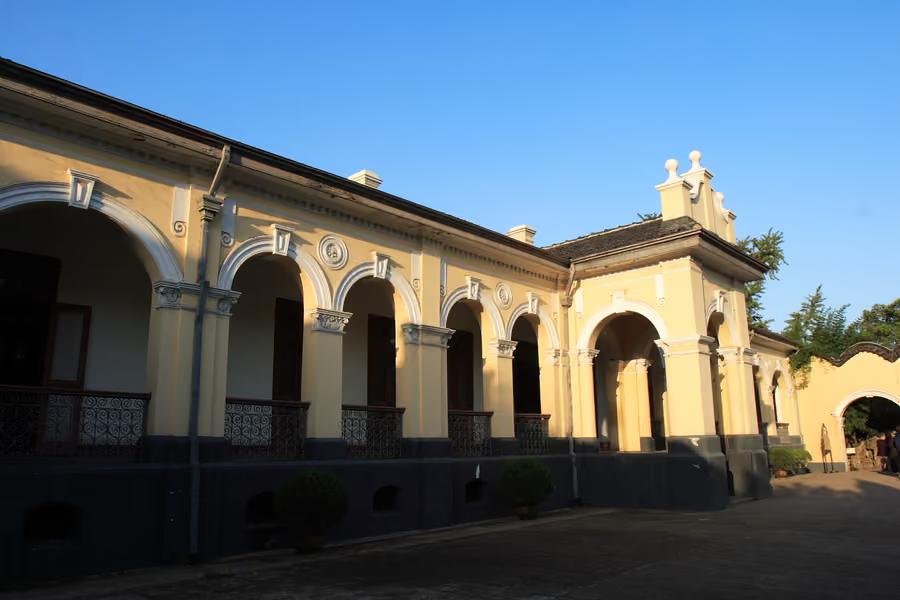
No other site in China has housed so many governments. It was a Ming prince's manor, then the residence of the Qing viceroy of the Two Jiangs, and a detached palace used by the Qianlong Emperor. Hong Xiuquan's Taiping forces expanded it into the Palace of the Heavenly King; when Qing troops retook Nanjing in 1864 Zeng Guofan had much of it burned. Sun Yat-sen was sworn in here as provisional president of the Republic of China in 1912. From 1927 to 1949 it was the Nationalist government's headquarters, occupied during the war by Wang Jingwei's Japanese-backed administration, and renamed the Presidential Palace after 1948. Communist forces took Nanjing in April 1949. Most of the standing buildings date from roughly 1870 to the 1930s, and the complex became a museum of twentieth-century Chinese history in the late 1980s.
What you’ll discover
Three parallel strands. Along the central axis, the main gate rebuilt in 1929, the main hall, second hall and reception hall, and the Presidential Building — six storeys of reinforced concrete finished in 1935, with the offices preserved. To the west, Xu Garden, a classical southern garden around Taiping Lake with a marble boat and the small building where Sun Yat-sen worked as provisional president. To the east, the Executive Houses, seat of the Executive Yuan from 1928 to 1937, partly rebuilt in 2003 on their original footprint. Galleries through the complex cover the Republican period.
A little local insight
Good to know before you go
- Allow three hours. People budget an hour for 'a palace' and find a very large museum of modern Chinese history with the garden attached.
- Xu Garden at the west end is the part most visitors run out of time for, and it is the most pleasant hour in the complex — a proper Jiangnan garden inside a government compound.
- Go up inside the 1935 Presidential Building to the preserved offices. The contrast between the concrete modernism here and the Qing courtyards fifty metres away is the whole point of the site.
- The same ground held a Qing viceroy, the Taiping Heavenly King, Sun Yat-sen, Chiang Kai-shek and a Japanese puppet regime. Read the labelling in that order and the complex becomes legible instead of confusing.
- It is a ten-minute walk from Zhujiang Road metro and close to the 1912 bar district, which makes it a straightforward half-day with dinner attached.
When to come
A weekday morning, spring or autumn. Much of the visit is outdoors between buildings, so avoid high summer and heavy rain.
Getting around
Fair. The main courtyards and the axis are flat and paved, and the newer gallery buildings have lifts, so a substantial part of the visit works in a wheelchair. The obstacles are raised thresholds at the historic halls, steps into several buildings, and the garden, where paths are narrow, stone-paved, uneven, and crossed by bridges with steps. The upper floors of the Presidential Building are reached by stairs. A bad knee will manage with frequent rests; the complex is large and the walking adds up.
Worth knowing before you go
The rear garden (Xu Garden) is the quiet half most tour groups never reach.
Compare established providers
Check live tours and tickets
Search for Presidential Palace in Nanjing. Prices, availability, payment and confirmation are handled by the booking provider.
China Travel Select does not take payment or create the reservation. Confirm the exact name, dates, inclusions and cancellation rules on the provider’s page.
Take a closer look
Maps, videos & more
Prices and hours change. These are the places to check on the day.