Discover Shanghai
Shanghai Astronomy Museum
上海天文馆
The largest purpose-built planetarium in the world, opened in 2021 out at Lingang, with no straight lines anywhere in the building and a genuinely spectacular orbital design. Chinese families rate it among the best museums in the country; foreign visitors rarely make the trip.
The story
What makes this place special
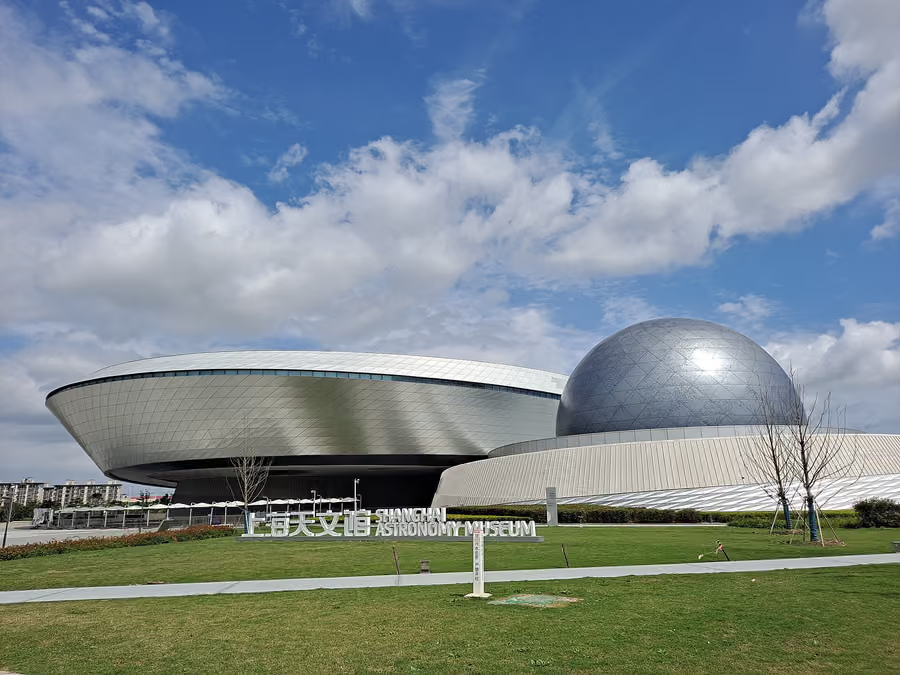
A branch of the Shanghai Science and Technology Museum, opened in 2021 in Lingang New City at the far south-eastern edge of Pudong, and described as the largest planetarium in the world by building scale, with a dome covering 38,000m². It was designed by Ennead Architects of New York, who built it with no straight lines and no right angles anywhere: the design partner Thomas J Wong described the intention as embodying the fundamental laws of astrophysics in the architecture itself, so the building's curves, orbits and apertures are the first exhibit.
What you’ll discover
A white curved building whose forms track the movement of light - a circular aperture over the entrance that casts a moving disc of sunlight across the floor through the day, a glazed sphere housing the planetarium theatre, an inverted dome you can stand under open to the sky, and a long spiralling ramp that organises the galleries. Inside are exhibition halls on the solar system, the universe and the history of observation, a planetarium theatre, meteorite specimens, and a separate observatory building with a public telescope.
A little local insight
Good to know before you go
- The building is the reason to come, more than the displays. Give yourself time on the ramps, under the inverted dome and at the oculus, and go on a sunny day so the light effects work at all.
- It is a long way out - the far end of Pudong at Lingang, well over an hour from central Shanghai. Treat it as a day trip, not an afternoon, and check the metro line's end-of-service times.
- Book well ahead and book the planetarium theatre and the telescope sessions separately when you book entry; they have limited capacity and sell out before general admission does.
- Much of the exhibition labelling is aimed at Chinese schoolchildren, and English coverage is patchy - adults come for the architecture and the planetarium show, families come for the galleries.
- Avoid school holidays and weekends if you can. It was built for very large numbers of visitors and gets them.
- There is little else out at Lingang except the new waterfront, so eat in the museum or bring food; this is not a neighbourhood with options.
When to come
A clear, sunny weekday, as early as possible - sunlight is what makes the building's apertures and the moving light disc work, and the crowds build through the day. Any season; it is entirely indoors apart from the terraces.
Getting around
Very good. It is a new building designed around ramps rather than stairs, which makes the main circulation genuinely step-free and unusually pleasant in a wheelchair, with lifts, accessible toilets and seating throughout. The planetarium theatre has accessible seating positions - ask when booking. The caveats are the long distances inside the building, the gradient of the spiral ramps, which is easy to roll down and harder to push up, and the long journey out to Lingang.
Worth knowing before you go
This is a 60-90 minute ride from the city centre, so treat it as a full half-day and buy the planetarium dome show as a separate add-on when you book. The booking mini-programme needs a Chinese mobile number or passport details entered in advance.
Compare established providers
Check live tours and tickets
Search for Shanghai Astronomy Museum in Shanghai. Prices, availability, payment and confirmation are handled by the booking provider.
China Travel Select does not take payment or create the reservation. Confirm the exact name, dates, inclusions and cancellation rules on the provider’s page.
Take a closer look
Maps, videos & more
Prices and hours change. These are the places to check on the day.