Discover Xiamen
Shuzhuang Garden and Piano Museum
菽庄花园与钢琴博物馆
A 1913 private garden built out over the rocks so the sea washes into its courtyards, hiding a museum of around a hundred historic pianos. Gulangyu produced so many musicians it is nicknamed Piano Island.
The story
What makes this place special
Shuzhuang Garden was built in 1913 by Lin Erjia, a wealthy Taiwanese landowner whose family moved to the mainland after the Qing ceded Taiwan to Japan in 1895. He modelled it on his family's villa garden in Banqiao, Taipei, with reference to the classical gardens of the lower Yangtze, and named it Shuzhuang as a pun on his own courtesy name, Shuzang. It has two parts: Canghai ('hiding the sea') and Bushan ('mending the hill'), each with five set scenes. The garden passed into public hands in the mid-1950s. The Gulangyu Piano Museum inside it was created in 2000 by the pianist Hu Youyi, born on Gulangyu in 1936 and trained at the Royal Conservatory in Belgium, who gave his own collection — described as close to a hundred historic pianos and candelabra, including some seventy antique European and American instruments. He added an organ museum on the island in 2005.
What you’ll discover
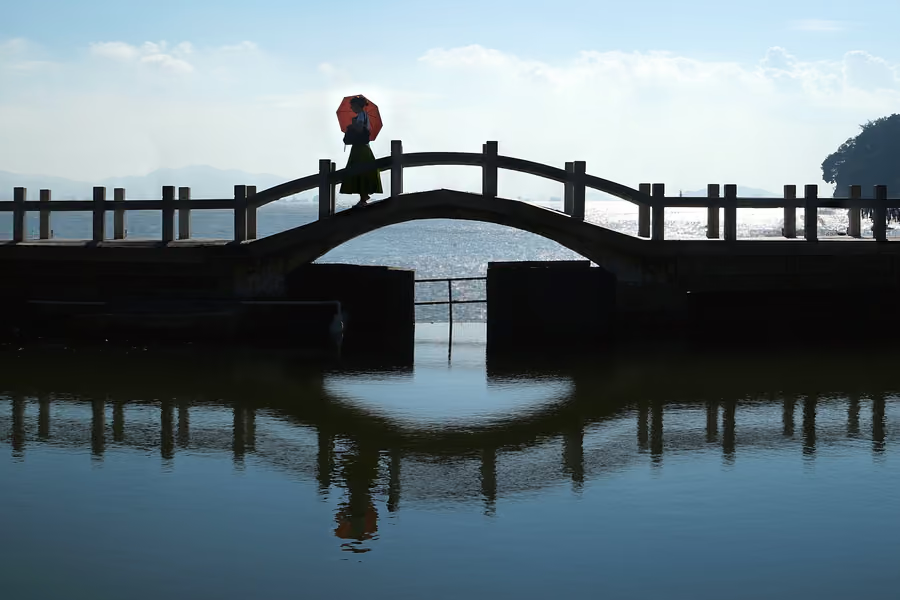
The garden's trick is that it is built out over the sea rather than facing it. The Forty-Four Bridge — named for the owner's age when he built it — zigzags across a tidal inlet with sluice gates that let the sea into the garden's outer and inner pools, so sea, pool and pond become three levels of the same water and the garden appears to contain the ocean. Hence the name Canghai, hiding the sea. Behind it the Bushan section climbs into rockwork with twelve miniature grottoes, a pavilion for listening to the tide, and a small orchid court. The piano museum occupies buildings within the garden and holds the historic instruments, with photography generally not permitted.
A little local insight
Good to know before you go
- Go at high tide. The entire design depends on sea water being in the pools and under the bridge; at low tide you are looking at mud and the garden loses its point. Check the tide table before choosing your hour on the island.
- Walk the Forty-Four Bridge slowly and look back. The zigzag is calculated so that each turn frames a different composition of rock, water and open sea — it is the single cleverest piece of landscape design in Xiamen.
- The piano museum is included with the garden and is a real collection, not a gimmick — nineteenth-century European grands, square pianos, and the instruments the island's musicians learned on. Allow it half an hour.
- This is the best thing on Gulangyu in bad weather, because much of it is covered, and it is at the quiet southern end of the island away from the main lanes.
- Monday afternoons and weekday mornings out of season you can have the garden nearly to yourself; in holiday periods the bridge is a single-file procession.
When to come
High tide, on a weekday, in autumn or winter. Late afternoon light across the water is the best of it, and the sea breeze makes it the coolest spot on the island in summer.
Getting around
Partly manageable. The Canghai section, the bridge and the waterside pavilions are largely level with some steps and narrow passages, and much of it can be done in a wheelchair with help, though the bridge is narrow and gets congested. The Bushan rockwork and its twelve grottoes are steps and tight stone passages and are not accessible. The piano museum buildings have steps at the doors. Getting to the garden from either ferry pier involves the island's hills.
Worth knowing before you go
Sit in the Forty-Four Bridge pavilion at high tide - the garden was designed so the waves reach you.
Compare established providers
Check live tours and tickets
Search for Shuzhuang Garden and Piano Museum in Xiamen. Prices, availability, payment and confirmation are handled by the booking provider.
China Travel Select does not take payment or create the reservation. Confirm the exact name, dates, inclusions and cancellation rules on the provider’s page.
Take a closer look
Maps, videos & more
Prices and hours change. These are the places to check on the day.