Discover Beijing
Lama Temple (Yonghegong)
雍和宫
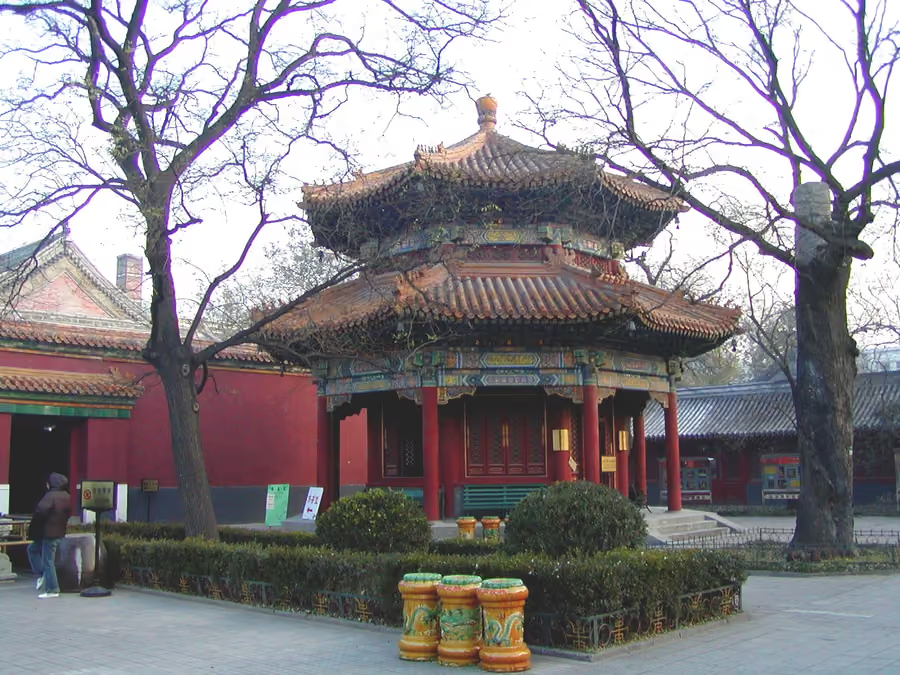
Beijing's great Tibetan Buddhist monastery, converted from a Qing prince's palace and still a busy working temple rather than a museum. The back hall holds an 18-metre Maitreya Buddha carved from a single sandalwood trunk.
The story
What makes this place special
This began as a palace, not a temple: built from 1694, it became the residence of Prince Yong, who took the throne as the Yongzheng emperor in 1722. The Qianlong emperor converted it to a Tibetan Buddhist lamasery of the Gelug school by edict in 1744, which made it a working instrument of Qing policy towards Tibet and Mongolia as much as a place of worship. Its best-known object is the Maitreya Buddha in the Pavilion of Ten Thousand Happinesses, carved from a single block of white sandalwood, standing about 18m above the floor with a further 8m or so below ground - roughly 26m in all. It was a gift to Qianlong from the seventh Dalai Lama and reportedly took three years to transport from Tibet.
What you’ll discover
A sequence of five halls on a short north-south axis, rising in scale as you go: the Gate Hall of Harmony and Peace, the main Hall of Harmony and Peace, the Hall of Everlasting Protection, the Hall of the Wheel of the Law with its large Tsongkhapa statue and the carved Five Hundred Arhats mountain, and finally the tall Pavilion of Ten Thousand Happinesses built around the sandalwood Maitreya - you crane upwards inside a narrow shaft of a building. Unlike most Beijing monuments this is a functioning temple, thick with incense smoke, with maroon-robed monks and Chinese and Mongolian worshippers prostrating and offering bundles of incense in the courtyards.
A little local insight
Good to know before you go
- Free incense is handed out at the entrance; take a bundle and light it at the burners in each courtyard if you want to, but do not light it inside the halls and do not photograph inside them - the no-photography rule in the halls is enforced here, unlike at the imperial sites.
- Come early on a weekday. On the first and fifteenth days of the lunar month, and at Lunar New Year, the courtyards are solid with worshippers and the queue starts out on the street - which is either the reason to come or the reason to avoid it.
- Look up in the Hall of the Wheel of the Law at the carved arhat mountain, and look at the Tibetan-style murals and the tangkas rather than only the statues. The temple's collection is Tibetan and Mongolian, which makes it quite unlike the Chinese temples elsewhere in the city.
- The Maitreya pavilion is the last hall and the crowd pools there. Walk through to it first and view the earlier halls on the way back out if you are there at a busy hour.
- Combine it with the Confucius Temple and the Imperial Academy, five minutes' walk west on Guozijian Jie - a quiet, tree-lined old street with the stone stele forest of examination graduates, and far fewer visitors.
- Yonghegong Lama Temple metro station puts you at the gate, and the surrounding street is lined with shops selling Buddhist supplies rather than souvenirs - worth a look in its own right.
When to come
Within the first hour of opening, any weekday, for the slanting light through the incense smoke and relative quiet. Avoid lunar first and fifteenth days and the New Year period unless you want the crowd. Winter mornings are especially good here - cold, smoky and nearly empty.
Getting around
Reasonable on the flat, awkward at the thresholds. The courtyards are level stone paving and the distance from gate to last hall is short - a few hundred metres - so the overall layout suits limited mobility better than most Beijing sites. But each hall sits on a platform reached by several steps, with high raised timber thresholds in the doorways and no ramps, so a wheelchair user can cross the courtyards and see the buildings but will need help to get inside any of them. There is loose gravel in places and incense smoke throughout, which is worth knowing with asthma.
Worth knowing before you go
Treat the booking rule as unconfirmed - reserve online a few days ahead through the WeChat account so you are covered either way. It is an active place of worship: go early, keep quiet in the halls, and do not photograph people praying.
Compare established providers
Check live tours and tickets
Search for Lama Temple (Yonghegong) in Beijing. Prices, availability, payment and confirmation are handled by the booking provider.
China Travel Select does not take payment or create the reservation. Confirm the exact name, dates, inclusions and cancellation rules on the provider’s page.
Take a closer look
Maps, videos & more
Prices and hours change. These are the places to check on the day.