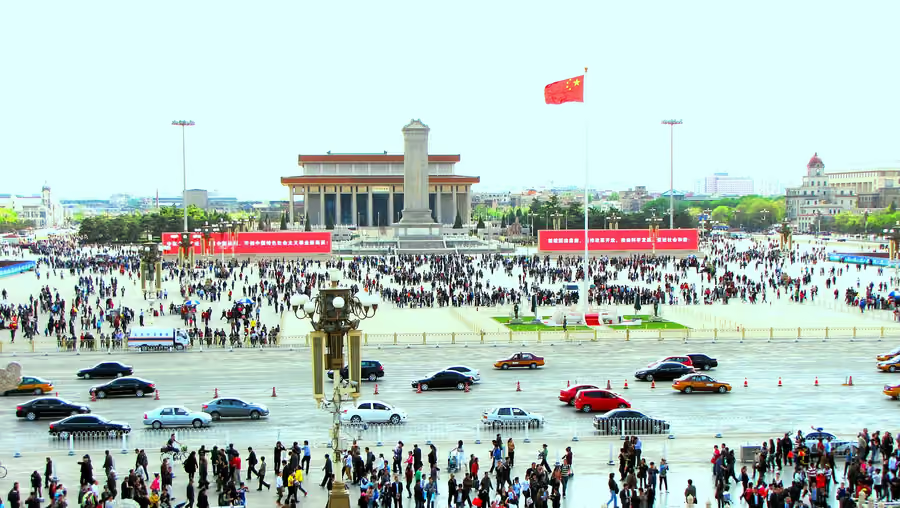
Discover Beijing
The Palace Museum (Forbidden City)
故宫博物院
The vast imperial palace of the Ming and Qing emperors, and the single sight most visitors build a Beijing trip around. Walking the central axis from Meridian Gate to the Imperial Garden takes you through nearly five centuries of court life.
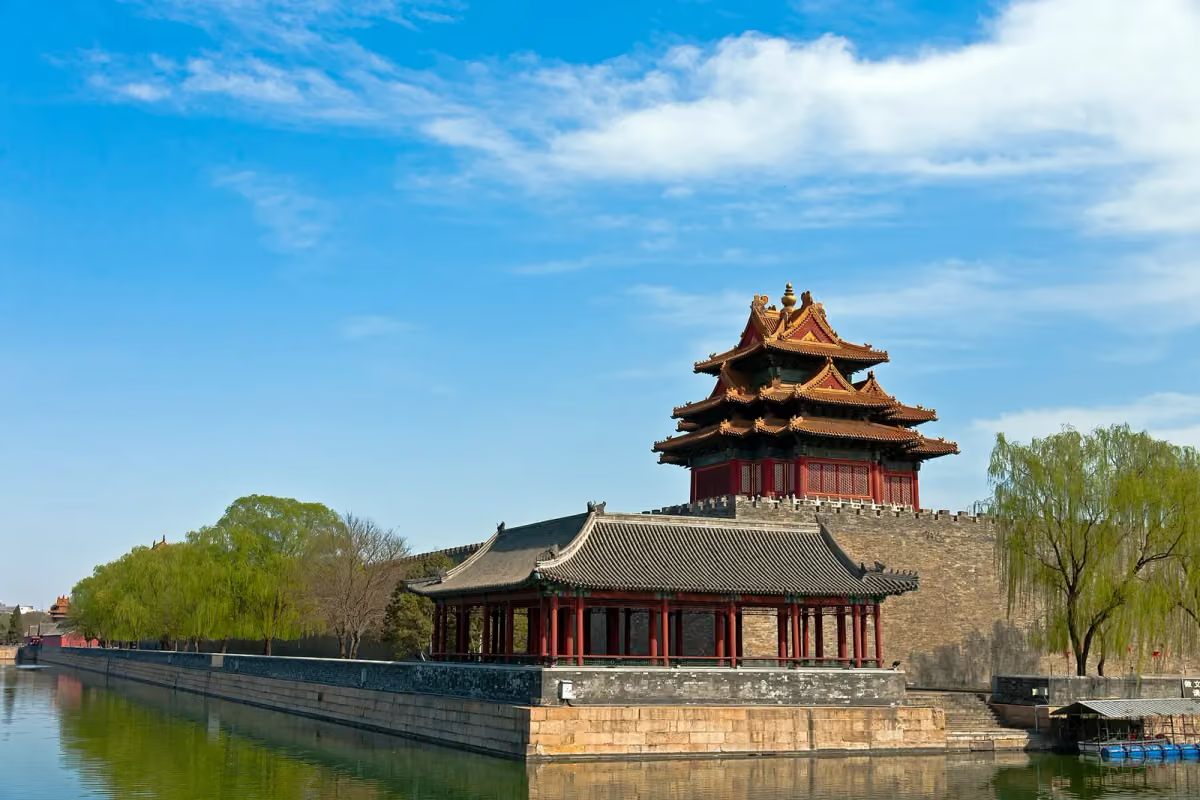
The story
What makes this place special
The palace was built between 1406 and 1420 after the Yongle emperor moved the Ming capital from Nanjing to Beijing, and it housed the court of 24 emperors across the Ming and Qing dynasties until 1912, when the child emperor Puyi abdicated. Puyi was allowed to stay in the northern apartments until he was evicted in 1924, and the Palace Museum opened to the public in 1925. In 1933, with Japanese forces advancing, museum staff crated up the most valuable objects and shipped them south; part of that convoy was taken to Taiwan in 1948, which is why the finest imperial collection is split between Beijing and Taipei. Roughly 980 buildings survive on a 72-hectare walled rectangle measuring 961m north to south by 753m east to west.
What you’ll discover
Visiting is one-way: you enter under the Meridian Gate in the south and walk north, and you cannot double back. The first stretch is the ceremonial axis - a vast empty paved court, then the three great halls on their marble terrace (Supreme Harmony, Central Harmony, Preserving Harmony), where you look in through open doors rather than walking inside. North of those the scale shrinks into the inner court, the emperor's and empress's own residences, and the small rockery-filled Imperial Garden before the exit at the Gate of Divine Might. The parts most worth paying extra attention to are off this axis: the Treasure Gallery in the north-east with the Nine Dragon Screen and the imperial jades and gold, and the clock gallery, from a collection of over a thousand 18th and 19th-century mechanical timepieces.
A little local insight
Good to know before you go
- Go straight up the axis to the three great halls first and look at the side courts afterwards. Tour groups are funnelled up the middle in a slow mass from opening until about 11am, and the eastern and western side palaces are nearly empty while that is happening.
- The two paid side galleries - the Treasure Gallery and the clock gallery, both in the eastern section - are where the actual objects are. Most visitors walk the axis, see empty halls through railings, and leave thinking the Forbidden City contains nothing.
- Climb up onto the Meridian Gate itself (there is a lift on the accessible route). The gallery along the top gives the only view down the axis from height inside the walls, and it usually houses the museum's main loan exhibition.
- You exit at the north gate, which is directly across the road from Jingshan Park. The hill in Jingshan is the standard way to photograph the whole palace from above, and the two are designed to be done in one trip.
- Walking the axis and one side route is 3km minimum on hard stone paving, with no shortcut once you are inside and almost no shade in the great courts. Fill a bottle at the water points before the long open stretches.
- Bring your passport - it is the ticket, it is checked at the gate, and the name on the booking must match it.
When to come
Enter in the first slot of the morning, or after about 2pm when the morning coach groups have left; mid-morning is the worst. Late autumn (October-November) and April are the best seasons - the courts are brutally hot and shadeless in July and August, and the exposed stone is bitter in a January wind.
Getting around
Better than its reputation. There is a barrier-free route of roughly a kilometre from the Meridian Gate in the south to the Gate of Divine Might in the north, created for the 2008 Paralympics, with a lift up to the Meridian Gate gallery that avoids about 100 steps, and stair lifts to the terraces of the three great halls. Wheelchairs can be borrowed at the Meridian Gate. The caveats are real: the paving is large, uneven, ridged stone slabs that are hard work to push, old doorways have raised timber thresholds, the side palaces and garden rockeries are largely out of reach, and the underpass used to cross the road to the south entrance has steep ramps. A visitor with a bad knee can do the axis; stairs are unavoidable only if you want to go up on the walls or gates.
Worth knowing before you go
The museum states it has never authorised any third-party reseller, so book through the official mini-program with your passport number, and bring the physical passport - it is scanned at the gate. Entry is one-way from south (Meridian Gate) to north, so plan your onward route from the north exit.
Compare established providers
Check live tours and tickets
Search for The Palace Museum (Forbidden City) in Beijing. Prices, availability, payment and confirmation are handled by the booking provider.
China Travel Select does not take payment or create the reservation. Confirm the exact name, dates, inclusions and cancellation rules on the provider’s page.
Take a closer look
Maps, videos & more
Prices and hours change. These are the places to check on the day.