Discover Beijing
Summer Palace
颐和园
The Qing court's lakeside retreat: a 300-hectare landscape of willow causeways, covered walkways and hilltop temples wrapped around Kunming Lake. It is the best place in Beijing to see how imperial China designed scenery rather than buildings.
The story
What makes this place special
The Qianlong emperor began dredging and reshaping the lakes and hill here in 1749 and finished the garden, then called Qingyiyuan, in 1764 at a cost of over 4.8 million silver taels. British and French troops burned it along with the nearby Old Summer Palace in December 1860. Empress Dowager Cixi rebuilt and enlarged it from the 1880s, giving it the present name Yiheyuan in 1888 - the rebuilding is notoriously said to have been paid for with navy funds. It was damaged again by the Eight-Nation Alliance in 1900, restored about two years later, and inscribed as a UNESCO World Heritage site in 1998. Kunming Lake, about 2.2km² and three-quarters of the grounds, is entirely man-made.
What you’ll discover
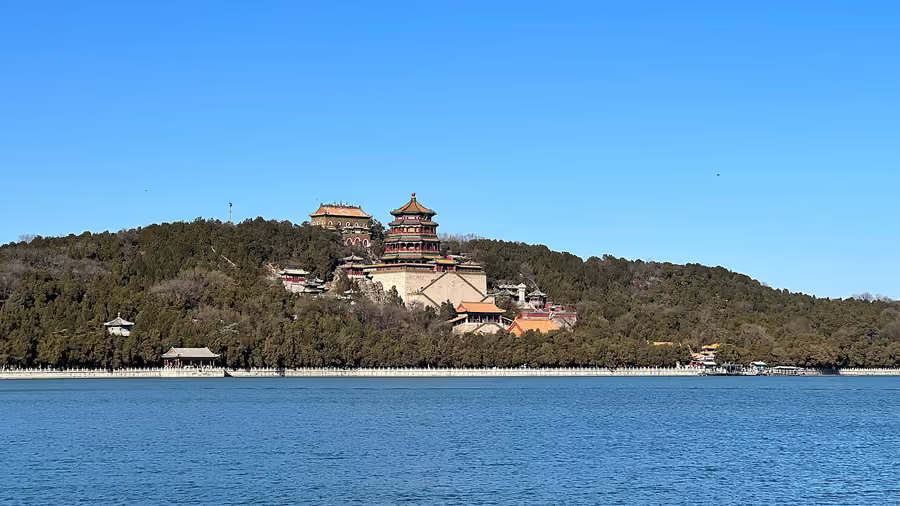
The core sequence is on the north shore: the Long Corridor, a covered painted walkway about 728m long running along the water, leading to the climb up Longevity Hill past the Hall that Dispels the Clouds to the Tower of Buddhist Incense, about 41m tall on a 20m stone base, which is the view everyone comes for. At the west end of the corridor is the Marble Boat, a 36m stone folly replacing a wooden pavilion burned in 1860. Across the water are the 150m Seventeen-Arch Bridge out to South Lake Island and the long willow-lined West Causeway. Behind the hill, reached over the top or round the end, is Suzhou Street, a reconstructed canal-side shopping lane (ordered in 1762, destroyed in 1860, rebuilt in 1988) that most visitors never find.
A little local insight
Good to know before you go
- The grounds are about 2.9km² and visitors routinely underestimate it by half. Plan half a day, and know that walking from the East Palace Gate out to the far west end and back is several kilometres with a hill in the middle.
- Take the boat across Kunming Lake rather than walking the shore twice. It saves about 40 minutes of repeated ground and is the only way to see the hill composition as it was designed to be seen - from the water.
- Enter at the North Palace Gate and walk south-east, not the usual way round. The north gate is right by the metro, it puts Suzhou Street and the quiet back-hill temples first, and you come over the hill to the Long Corridor after the coach groups have moved off it.
- The back of Longevity Hill is the best part of the garden and is nearly deserted - the Tibetan-style Four Great Regions temple terraces and the ravine walk are there.
- The West Causeway is a long, almost empty willow walk with views back to the hill; it is where locals go and where no tour goes.
- Winter is worth considering: the lake freezes, the crowds collapse, and the bare composition of hill, bridge and pagoda is clearer than in summer haze.
When to come
Early morning or the last two hours before closing, in spring or autumn. Summer weekends and Chinese public holidays are genuinely unpleasant on the Long Corridor. Winter is cold but clear and empty.
Getting around
Mixed, and it depends entirely on which half you attempt. The lakeside is flat, paved and easy: the Long Corridor, the Marble Boat, the East Gate area, the Seventeen-Arch Bridge and the causeways are all manageable in a wheelchair or with a bad knee, and the cross-lake boat plus a taxi between gates removes most of the distance problem. Longevity Hill is not manageable - the climb to the Tower of Buddhist Incense is long flights of stone steps with no lift, and the back-hill terraces are steeper still. Suzhou Street sits in a ravine reached by steps. Treat it as a lake visit with the hill as an optional extra, and budget for the sheer distance between gates.
Worth knowing before you go
Enter at Beigongmen and walk south over Longevity Hill, then take the lake boat or the Long Corridor back - you see the whole composition and end near the metro rather than doubling back. The ¥60 combined ticket is worth it only if you want the Tower of Buddhist Incense climb.
Compare established providers
Check live tours and tickets
Search for Summer Palace in Beijing. Prices, availability, payment and confirmation are handled by the booking provider.
China Travel Select does not take payment or create the reservation. Confirm the exact name, dates, inclusions and cancellation rules on the provider’s page.
Take a closer look
Maps, videos & more
Prices and hours change. These are the places to check on the day.