Discover Chengdu
Jinsha Site Museum
金沙遗址博物馆
A 3,000-year-old Bronze Age religious site discovered under a Chengdu building project in 2001, left open as an excavation hall plus a treasury of gold, jade and ivory. The gold 'Sun and Immortal Birds' disc found here is now the emblem of Chinese cultural heritage - and of Chengdu itself.
The story
What makes this place special
On 8 February 2001 workers digging a drain for a housing project about 5km from central Chengdu cut into a deposit of bronze, jade, stone and ivory; excavation began the next day and the site was named Jinsha. It is understood as a capital of the Shu state in the late Shang to early Western Zhou, succeeding Sanxingdui after that centre declined, and it was abandoned at some point in the following centuries for reasons still unclear. Its best-known object is the Golden Sun Bird, a thin disc of 94 per cent gold with a twelve-pointed sun at the centre and four birds flying around the rim, now the museum's emblem and a national symbol. Unlike Sanxingdui, Jinsha had no city walls or moats.
What you’ll discover
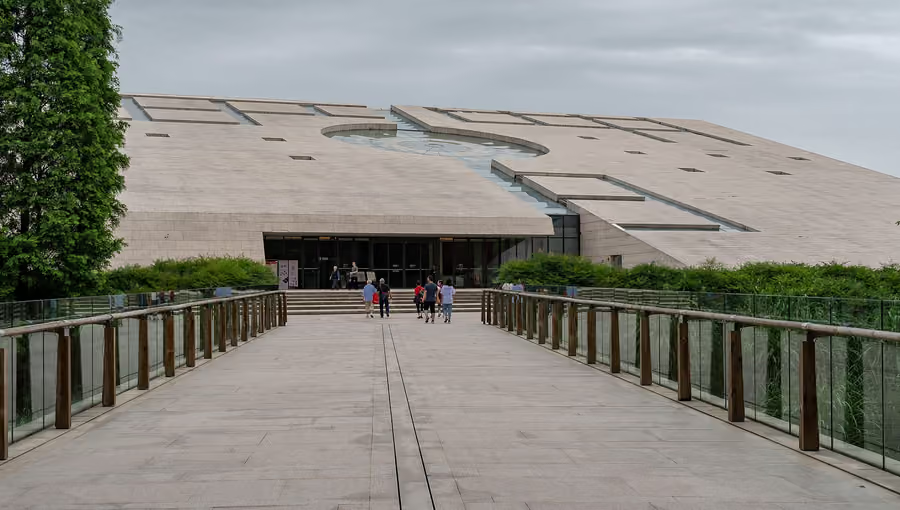
Two buildings in a park. The first is the excavation hall, a shelter built over the dig itself covering around six hectares, where you walk on raised walkways above the open pits and can see the elephant-tusk deposits and ivory layers in the ground where they were found. The second is the relics hall, which holds the objects: the Golden Sun Bird on the upper floor, the small smiling gold mask barely 4cm across with crescent eyes, the twelve kneeling stone figures with bound hands - probably shamans or sacrificial victims - and the stone snakes and tigers found with them.
A little local insight
Good to know before you go
- Do the excavation hall first and the relics hall second. In that order the objects make sense; the other way round the pits look like mud.
- The gold mask is tiny and is easy to walk straight past. Find it deliberately - it is one of the most remarkable objects in China and is smaller than a credit card.
- This is the pairing with Sanxingdui, not an alternative to it. If you are seeing both, Jinsha is the city and Sanxingdui the earlier centre; if you can only do one and are short of time, Jinsha is inside Chengdu while Sanxingdui is a long day trip.
- It is substantially less crowded than Chengdu's other big museums because it is away from the centre, so it is a good choice on a weekend when the Sichuan Museum is full.
- Allow two to three hours and bring interest in archaeology rather than spectacle - the ivory pits and the stone figures reward reading the panels.
When to come
Any time; it is indoor and climate-controlled, which makes it the right call on a hot or wet day. Weekday mornings are quietest, and it is busiest on weekend afternoons and during school holidays.
Getting around
Good. Both halls are modern purpose-built museum buildings with lifts, ramps and level floors, and the excavation hall is viewed from built walkways rather than from the ground, so there is no rough terrain. The park between the two buildings is flat paved path. Fully usable in a wheelchair; the only real demand is the walking distance between and within the halls.
Worth knowing before you go
The Monday closure is suspended in January, February, July and August, so a Monday in those months is actually a good quiet time to go. See the excavation hall first, then the exhibition building.
Compare established providers
Check live tours and tickets
Search for Jinsha Site Museum in Chengdu. Prices, availability, payment and confirmation are handled by the booking provider.
China Travel Select does not take payment or create the reservation. Confirm the exact name, dates, inclusions and cancellation rules on the provider’s page.
Take a closer look
Maps, videos & more
Prices and hours change. These are the places to check on the day.