Discover Inner Mongolia
Five Pagoda Temple
五塔寺 (金刚座舍利宝塔)
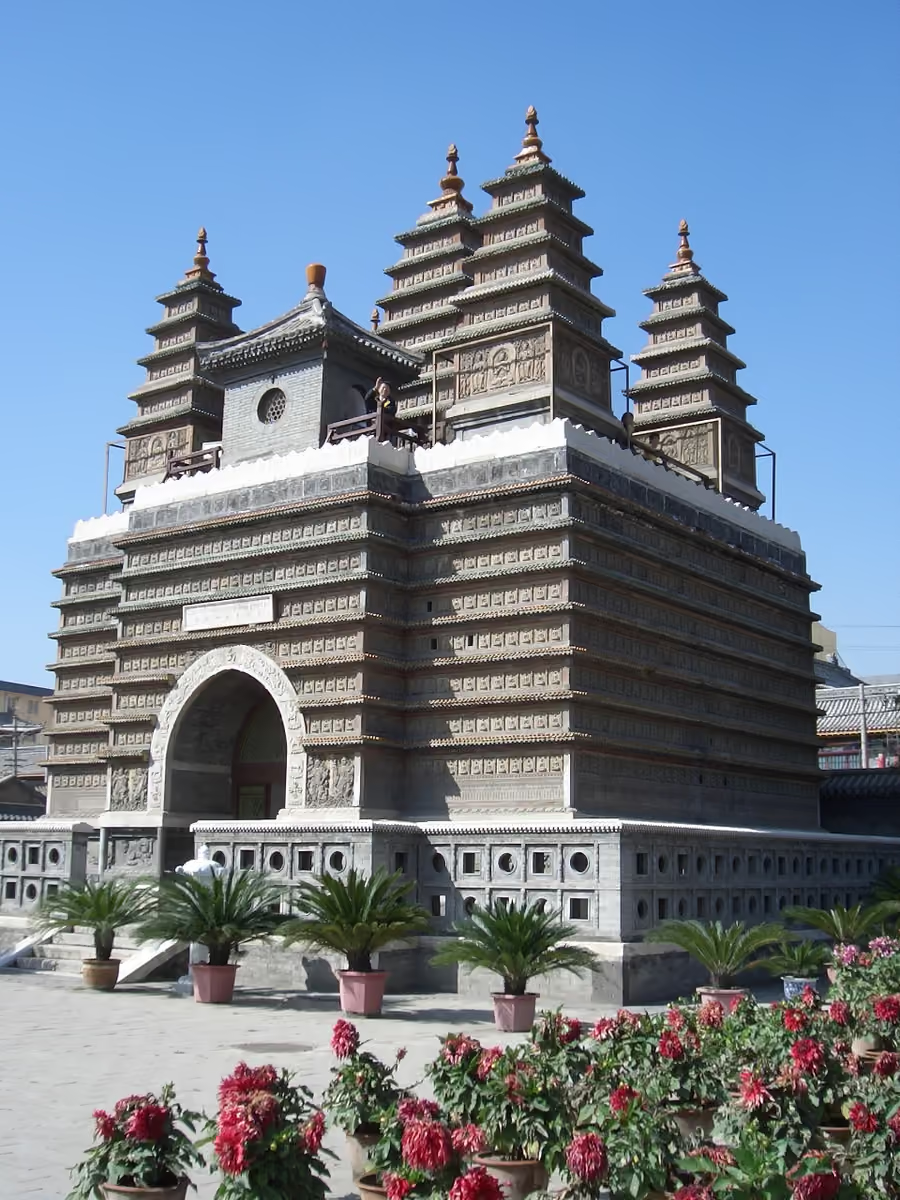
All that survives of the Qing-era Cideng Monastery is its extraordinary Diamond Throne pagoda - a 16-metre glazed-brick block carrying five small pagodas and covered in reliefs and Sanskrit, Tibetan and Mongolian inscriptions. On the back wall is a Mongolian-language star chart, thought to be the only one of its kind.
The story
What makes this place special
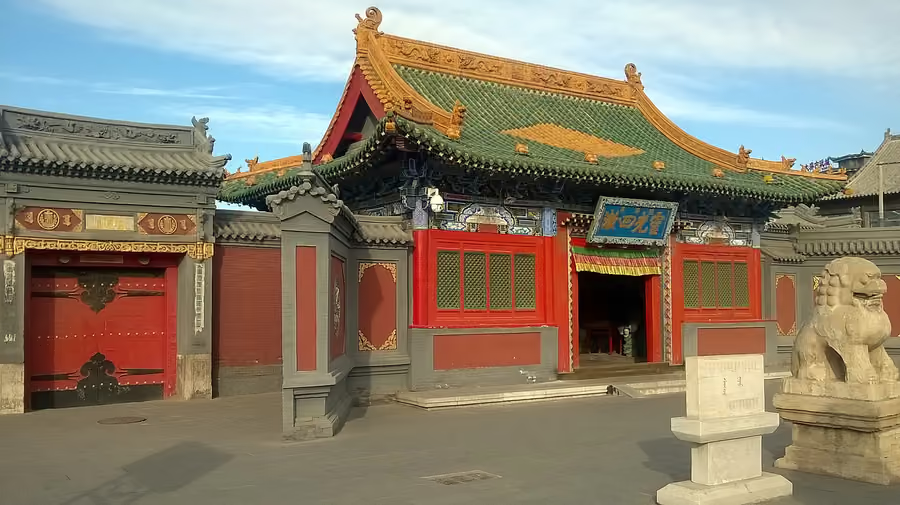
The Five Pagoda Temple is properly Cideng Temple, a Gelug monastery in Yuquan District, Hohhot, whose mother house was Xiaozhao. A Xiaozhao lama, Yangchar Jisi, applied to build it in 1727 and it was completed in 1732, when the Qing court granted it a name and plaques in Mongolian, Tibetan and Chinese. It originally covered about 13,500 square metres with three courtyards of halls, but declined after the death of the third Yangchar Jisi in 1886, and by the late 1960s only the Diamond-Throne Relic Pagoda remained. Liang Sicheng and colleagues surveyed the pagoda in 1961 and rated it highly; it was listed in the third national batch of protected monuments in 1988. In 2006 the Hohhot government funded a reconstruction of the temple around it, the first ancient building group in Inner Mongolia restored on its original site. The pagoda is 16.5m high, a diamond-throne type carrying five small close-eaved stupas, the central one of seven storeys and the four corner ones of five, with gilded Buddha figures in niches under the throne eaves, numbered in the Chinese source at 1,119. Three carved stone charts are set into the wall behind it, one of which is a Mongolian-language astronomical chart described as the only surviving stone star chart in China labelled in a minority language. Five pagodas of this type survive nationally, the others being in Beijing and at Miaozhan Temple in Kunming.
What you’ll discover
A compact courtyard with the pagoda standing alone at its centre: a square brick-and-stone throne densely covered on all four faces with small gilded Buddhas in niches, inscriptions in several scripts, and five stupas rising from its flat top. Behind it, set into a screen wall, are the three stone charts, the astronomical one being a circular star map with Mongolian labels. The reconstructed halls around the courtyard are new and largely empty.
A little local insight
Good to know before you go
- The Mongolian star chart on the rear wall is the single most unusual object in Hohhot and almost every visitor photographs the pagoda front and leaves without walking round the back. Go round the back.
- Count on twenty minutes for the pagoda and five for everything else. The surrounding temple is a 2006 reconstruction and holds nothing.
- Look closely at the niches. The figures are individually modelled and the inscription bands carry Sanskrit, Tibetan, Mongolian and Chinese on the same monument, which is the point of the thing.
- It is a short walk from Dazhao and Xilitu Zhao through the old Yuquan streets, so all three plus the Great Mosque make one compact half day on foot.
- Morning or late afternoon light rakes across the carved faces and shows the relief; at midday the detail flattens out.
When to come
Morning or late afternoon for raking light on the carved faces. May to September; Hohhot winters are severely cold and the courtyard is fully exposed.
Getting around
Good for a historic site. The courtyard is flat paving at ground level and the pagoda is viewed from outside rather than climbed, so a wheelchair user and anyone with a bad knee can see everything that matters. The reconstructed halls have the usual steps and sills.
Worth knowing before you go
Go round to the rear of the pagoda for the Mongolian astronomical chart; most visitors photograph the front and miss it.
Compare established providers
Check live tours and tickets
Search for Five Pagoda Temple in Inner Mongolia. Prices, availability, payment and confirmation are handled by the booking provider.
China Travel Select does not take payment or create the reservation. Confirm the exact name, dates, inclusions and cancellation rules on the provider’s page.
Take a closer look
Maps, videos & more
Prices and hours change. These are the places to check on the day.