Discover Inner Mongolia
Xilitu Zhao Temple
席力图召
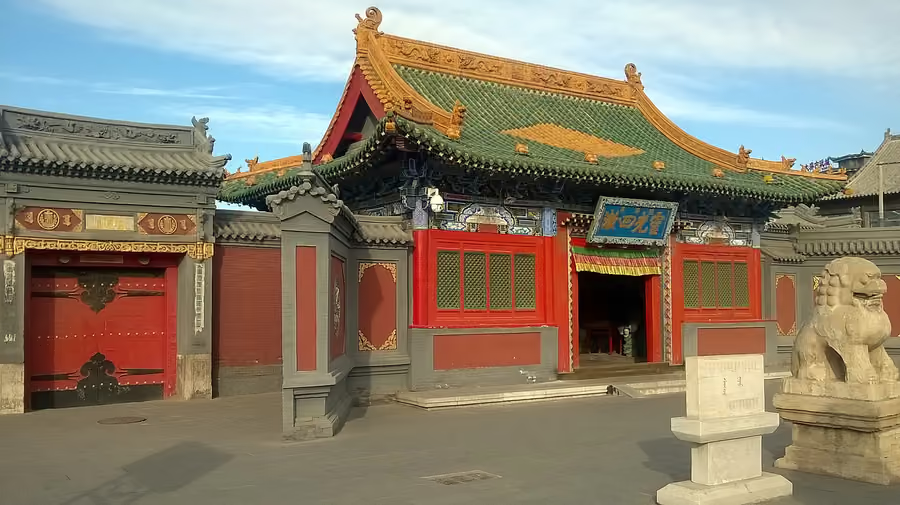
The seat of Hohhot's most senior lama and, architecturally, the most interesting monastery in the city - a Han-Chinese timber hall fronted by a Tibetan-style assembly hall faced in blue-glazed tile, with a white marble stupa in the courtyard. Quieter than Dazhao and still a working temple.
The story
What makes this place special
Xilitu Zhao, in Shitou Lane in Yuquan District, is one of Hohhot's seven great zhao and is described as the city's largest temple. The Mongolian name means roughly chief, or throne. It began in the Ming Longqing and Wanli reigns, between 1567 and 1619, as a small temple called Gufo Si founded by a son of Altan Khan. The first Xilitu incarnate lama presided, on behalf of the third Dalai Lama, over the search for the fourth, whose enthronement was held here, and the temple took its present name from that. In 1696 the Kangxi emperor attended a sutra assembly here and gave it the name Yanshou Si; a stele and pavilion were added in 1703. From 1708 the Xilitu lama normally served as chief lama of Guihua city, with the administrative office at the temple. It was listed as a national key cultural relic in 2013.
What you’ll discover
A paifang arch and mountain gate on the street, then a sequence of halls: a Bodhi hall, the main assembly hall, an ancient Buddha hall and a protector hall, with a white stupa in the courtyard and a bronze elephant. The main hall front is the thing to look at, a Tibetan-style facade of coloured glazed brick rather than the timber front you expect in a Chinese temple, and the stupa is the best-preserved Qing stupa in the city.
A little local insight
Good to know before you go
- Compare the two main temples directly: Dazhao is predominantly Chinese in form with a Tibetan interior, Xilitu Zhao's main hall front is Tibetan in form. They are five minutes apart and the contrast is the clearest architectural lesson in Hohhot.
- The white stupa in the courtyard carries the Kangxi connection and is often walked past. So is the Kangxi stele pavilion of 1703.
- Mornings have the monks and the chanting; afternoons have the tour groups from the rebuilt shopping street outside.
- The Yuquan district lanes around the temple, away from the reconstructed commercial strip, are the old Hohhot and the only part of the city with any pre-modern street pattern left.
- Hohhot's temples all close early in winter and the courtyards are brutally cold and windy from November to March. Go in the middle of the day in that season.
When to come
Morning for chanting and clear light on the glazed main-hall facade. May to September; Hohhot winters are extremely cold and the site is open to the wind.
Getting around
Fair. The courtyards are flat and level paving reached without steps from the street gate, so a wheelchair can get round the complex and see the stupa, the elephant and the hall facades. Hall interiors are entered up steps over raised sills with no ramps. A bad knee is not seriously impeded.
Worth knowing before you go
Monks still hold services here - go early morning if you want to see a chanting session rather than an empty hall.
Compare established providers
Check live tours and tickets
Search for Xilitu Zhao Temple in Inner Mongolia. Prices, availability, payment and confirmation are handled by the booking provider.
China Travel Select does not take payment or create the reservation. Confirm the exact name, dates, inclusions and cancellation rules on the provider’s page.
Take a closer look
Maps, videos & more
Prices and hours change. These are the places to check on the day.