Discover Nanjing
Confucius Temple and Qinhuai River
夫子庙秦淮风光带
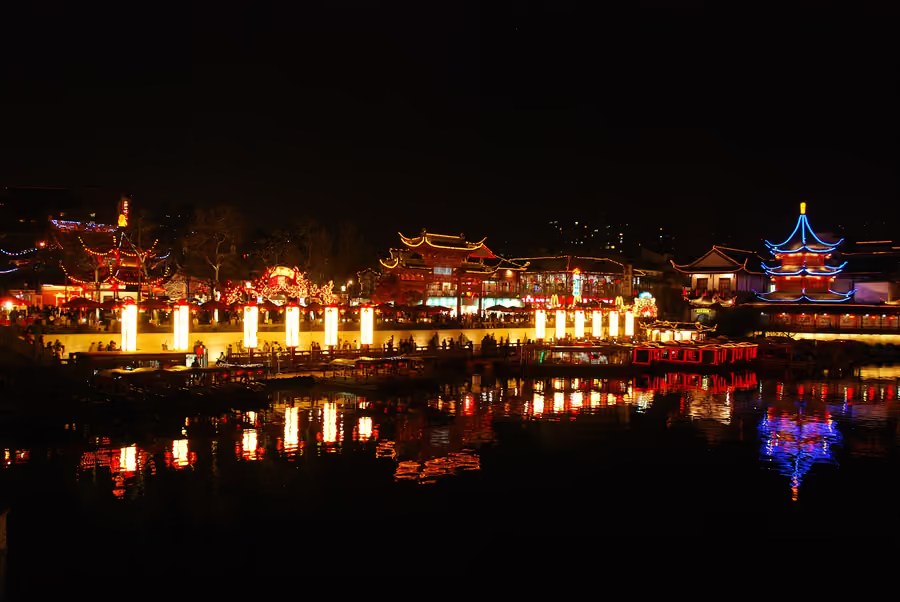
The restored heart of old Nanjing: a Confucian temple and imperial examination complex beside a canal lined with lantern-hung Ming-style houses. Touristy by day, genuinely beautiful lit up at night.
The story
What makes this place special
The Confucius Temple stands on the north bank of the Qinhuai River. The site goes back to an Eastern Jin academy traditionally dated to 337; the Confucian temple proper is generally said to have been built up from that academy in 1034, under the Northern Song. Immediately to its east was the Jiangnan Examination Hall, the largest imperial examination compound in China, where candidates from the lower Yangtze provinces sat for the civil service degrees; the site now houses the China Imperial Examination Museum, built largely below ground. The surrounding quarter was the pleasure district of late imperial Nanjing, and the present buildings are overwhelmingly late-twentieth-century reconstructions after wartime and earlier destruction.
What you’ll discover
A dense, bright, loud reconstructed quarter of upturned eaves, red lanterns, snack shops and souvenir stalls on both banks of a narrow canal, with painted pleasure boats working the water at night. The temple itself is a courtyard complex with a Confucius statue and the Dacheng Hall. The Examination Museum, reached by descending ramps into the ground, is the most substantial thing here and the part visitors most often skip. Nearby are the Wuyi Lane memorial hall to the Jin-dynasty statesmen Wang Dao and Xie An, and the Li Xiangjun house, a small restored courtyard associated with the late-Ming courtesan of 'The Peach Blossom Fan'.
A little local insight
Good to know before you go
- Go into the China Imperial Examination Museum. It is the serious attraction in the district — an underground museum on the system that selected China's officials for over a thousand years, on the ground where they sat the exams — and most visitors walk past the entrance to buy a snack.
- The Qinhuai boats are worth it at night and pointless by day. Buy the shorter stretch unless you particularly want the full run; the lit section is the first part.
- Eat in the lanes behind the waterfront, not on it. The riverside is the most expensive and least interesting food in Nanjing; one street back are duck-blood soup and pot-sticker places that locals use.
- Expect reconstruction. Almost nothing here is old, which is not a secret but surprises people who come expecting a surviving Ming quarter.
- Mid-morning on a weekday is the only quiet window. Evenings and holidays are a solid crowd, and during the Lantern Festival the quarter is effectively impassable.
When to come
After dark, when the lanterns and the boats make sense of the place; or mid-morning on a weekday if you want to see the temple and the museum properly. The Lantern Festival is spectacular and unbearably crowded.
Getting around
Mixed. The waterfront streets are flat and paved and largely pedestrian, so moving around the district is feasible, but it is very crowded and there are steps at bridges and at temple thresholds. The Examination Museum is modern with lifts and ramps and is accessible. Boarding the river boats requires steps down to a floating pontoon and is not realistic in a wheelchair. The temple halls have raised thresholds.
Worth knowing before you go
The Jiangnan Examination Museum next door, built down into the old cell blocks, is the most interesting part and most visitors walk past it.
Compare established providers
Check live tours and tickets
Search for Confucius Temple and Qinhuai River in Nanjing. Prices, availability, payment and confirmation are handled by the booking provider.
China Travel Select does not take payment or create the reservation. Confirm the exact name, dates, inclusions and cancellation rules on the provider’s page.
Take a closer look
Maps, videos & more
Prices and hours change. These are the places to check on the day.