Discover Nanjing
Nanjing City Wall - Zhonghua Gate
南京城墙·中华门
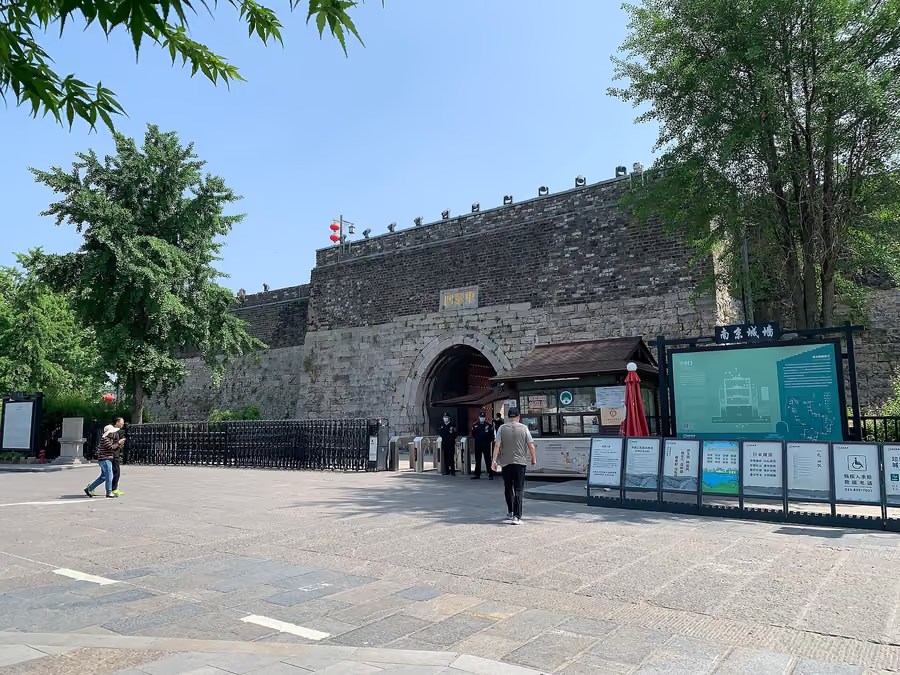
Nanjing kept more of its Ming city wall than any other Chinese city, and Zhonghua Gate is the largest surviving city gate in China - three successive barbicans, two horse ramps and 27 chambers that hid 3,000 soldiers.
The story
What makes this place special
Nanjing's Ming city wall was begun after the Hongwu Emperor made the city his capital in 1368 and took twenty-one years to build; it was listed as a nationally protected site in 1988, and about 25 kilometres survives. Zhonghua Gate, known under the Ming as Jubao Gate, is one of only two of the original thirteen gates still standing, and it is the most elaborate surviving city gate in China. It is a defence in depth: four successive arched gateways with three enclosed barbican courts between them, so that an attacker who broke the outer gate was trapped in a killing yard with walls on all sides. The castle measures roughly 128 metres north to south by about 118 metres east to west, with a wall thickness of over forty metres in places, and 27 vaulted chambers built into the masonry for storing grain and concealing troops.
What you’ll discover
You walk in through the four gateways in line and can see the slots where portcullises dropped. Off the courts, the 27 soldier chambers open as dark brick vaults you can enter. Ramps — horse ramps, wide enough to ride up — lead to the top of the gate, from which you look down into the barbican courts and along the wall. The bricks carry stamped inscriptions naming the kilns, counties and overseers responsible for them, a quality-control system you can read with your hands. From the gate you can walk the wall top towards Jiqingmen.
A little local insight
Good to know before you go
- The 27 soldier chambers are the point. Most visitors stand in the courtyards, photograph the gateways and leave without going into the vaults, which are the thing that makes this gate different from every other.
- Look at the bricks for stamped characters, especially on the inner faces of the barbican walls. Each names who made it and who was accountable — a six-hundred-year-old audit trail.
- Use the horse ramps, not the stairs, to get on top. They are gentler and they are what the structure was built for.
- The wall-top walk from Zhonghua Gate is one of the best urban walks in China and almost empty compared with the gate itself. Several separate stretches are open; this one and the Jiming Temple to Xuanwu Lake stretch are the two to choose from.
- Go late in the day. The brick takes low light well, the courts are shaded and hot at midday, and the crowd thins after four.
When to come
Late afternoon, spring or autumn. The barbican courts are sun traps in summer and the wall top has no shade at all.
Getting around
The ground-level gateways and barbican courts are broadly level on stone paving, with some uneven surfaces and raised sills, and are manageable in a wheelchair with help. The soldier chambers have a step and a low opening. Getting onto the wall top is by long masonry horse ramps — steep but stepless, so a strong pusher can do it, which is unusual and worth knowing; the alternative stairs are long. The wall top itself is uneven brick with no handrail in places. A bad knee can do the whole thing slowly using the ramps.
Worth knowing before you go
If you only walk one stretch, the Taicheng section gives you Xuanwu Lake on one side and Jiming Temple on the other.
Compare established providers
Check live tours and tickets
Search for Nanjing City Wall - Zhonghua Gate in Nanjing. Prices, availability, payment and confirmation are handled by the booking provider.
China Travel Select does not take payment or create the reservation. Confirm the exact name, dates, inclusions and cancellation rules on the provider’s page.
Take a closer look
Maps, videos & more
Prices and hours change. These are the places to check on the day.