Discover Shenzhen
Dapeng Fortress
大鹏所城
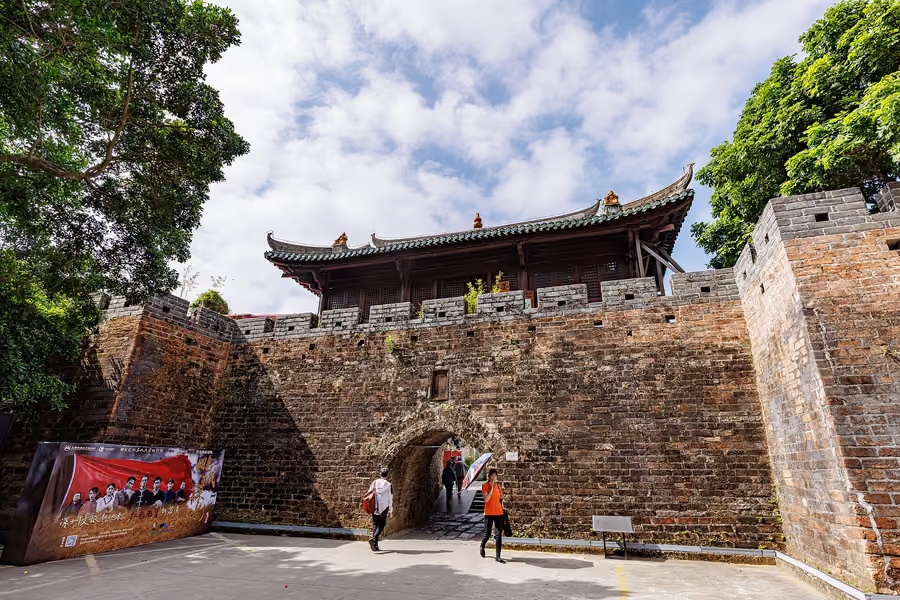
A walled Ming garrison town from 1394 at the far east of the municipality, with Qing generals' mansions, granite lanes and gates still standing. It is where the name Peng Cheng, Shenzhen's nickname, comes from.
The story
What makes this place special
Dapeng Fortress — properly the Dapeng Garrison Battalion walled town — was built in 1394, the 27th year of the Hongwu reign, under Zhang Bin, a battalion commander of the Guangzhou Left Guard, as a coastal defence post. Its jurisdiction covered the waters east of the Pearl River mouth including what is now Hong Kong, and it held that role through the Ming and Qing. The naval engagement at Kowloon in 1839, generally counted as the first action of the Opium War and of China's modern era, was fought in waters it administered; Lai Enjue, the commander associated with that fight, has his mansion here, the best-preserved of a dozen or so Qing general's houses inside the walls. The town covers about 100,000 square metres and retains its east, south and west gates and roughly 300 metres of wall base to the north-east. It was listed as a national key protected site on 25 June 2001, Shenzhen's first, and in 2003 as one of the first group of historic Chinese villages.
What you’ll discover
A genuine walled town on the Dapeng peninsula, not a reconstruction: stone-paved lanes on the original grid, grey-brick Qing houses, the three surviving gates, ancestral halls, and the general's mansions, several of which you can walk into. Lai Enjue's residence is large — dozens of rooms around high halls — and is the thing to prioritise. People still live here, so laundry hangs between the historic walls and there are village shops as well as cafés.
A little local insight
Good to know before you go
- This is the oldest thing in Shenzhen by five hundred years and almost no visitor goes. If you only do one trip out of the city centre, this is the one with substance.
- Go into the general's mansions rather than just walking the lanes. Lai Enjue's is the most complete and explains why a fishing peninsula produced a line of admirals.
- It is a long way out — east beyond Dameisha towards the Dapeng peninsula — and public transport means metro plus a bus. Allow the whole day and combine it with the Dapeng coast or Xichong.
- Go on a weekday. At weekends Shenzhen residents come out here in numbers and the lanes are a different place.
- Read the labelling on the Kowloon naval battle before you dismiss it as a village. The claim that modern Chinese history started in these people's patch of sea is made here and nowhere else.
When to come
Weekday mornings, October to April. Summer on the peninsula is very hot and the lanes offer little shade.
Getting around
Difficult. The lanes are original stone paving, uneven and broken in places, with high thresholds and steps at every house and hall doorway, and the gates have raised sills. Main lanes are broadly level, so a wheelchair user can get along the principal streets with a strong pusher but will not get inside most buildings. A bad knee will manage with care; wear shoes with grip, as the stone is slippery when damp.
Worth knowing before you go
Allow 1.5-2 hours each way from Futian, and pair it with Jiaochangwei beach or Yangmeikeng nearby.
Compare established providers
Check live tours and tickets
Search for Dapeng Fortress in Shenzhen. Prices, availability, payment and confirmation are handled by the booking provider.
China Travel Select does not take payment or create the reservation. Confirm the exact name, dates, inclusions and cancellation rules on the provider’s page.
Take a closer look
Maps, videos & more
Prices and hours change. These are the places to check on the day.