Discover Beijing
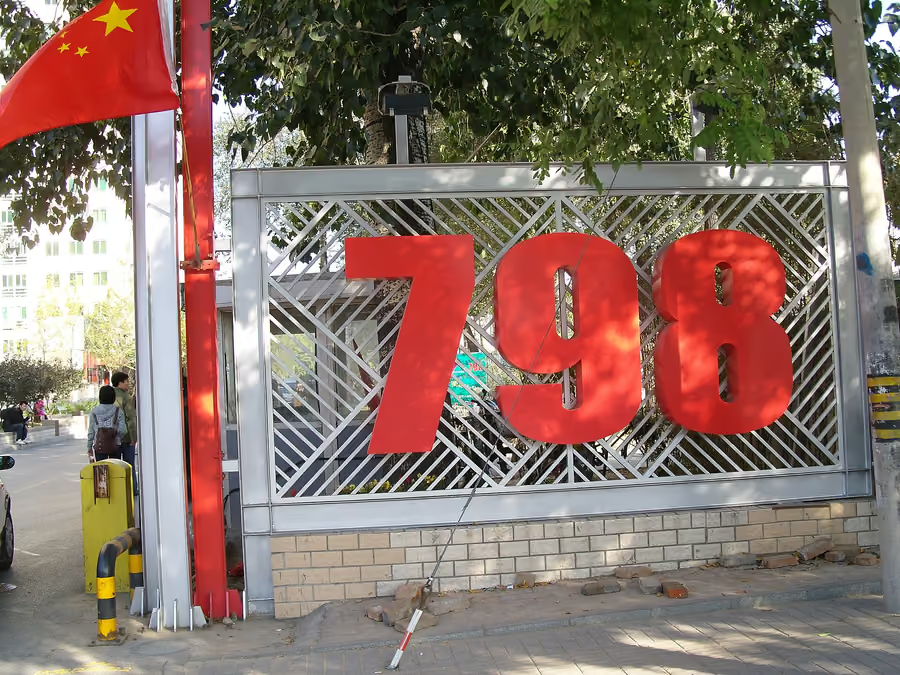
798 Art District
798艺术区
A 1950s Bauhaus-style East German factory complex turned into Beijing's biggest contemporary art quarter, with saw-tooth roofs, Maoist slogans still painted on the beams, and dozens of galleries. The best place to see what artists in China are making right now.
The story
What makes this place special
This was a secret military electronics complex, Joint Factory 718, built with Soviet and East German help - ground was broken in April 1954 and production started in 1957. The German engineers imposed a functional, Bauhaus-derived design rather than the ornate Soviet style: arched sawtooth roofs with north-facing clerestory windows to give even natural light, and a structure specified to survive a magnitude-8 earthquake, an argument that delayed construction by six months. The works was split into sub-factories, including 798, and most had stopped producing by the early 1990s. The Central Academy of Fine Arts took space in Factory 706 in 1995, galleries arrived around 2002, and after a 2005 eviction deadline and a 2006-07 redevelopment plan the area was formally kept as an art zone. The Cultural Revolution slogans still painted across the ceiling arches were kept at the tenants' request.
What you’ll discover
Wide industrial streets between brick workshops, with pipework running overhead at head height, rusted machinery left as sculpture, and galleries fitted into the sawtooth-roofed halls - the light inside them is the reason the whole place works as exhibition space. The anchor is UCCA, the main contemporary art institution in Beijing; around it are dozens of commercial galleries, artists' shops, design stores, cafes and a steadily growing proportion of fashion retail. The Maoist slogans on the arches are still legible inside several halls.
A little local insight
Good to know before you go
- Check what is actually on before you go. The galleries change completely every few weeks, some close between shows, and on a bad week it is an industrial estate with coffee. UCCA's current exhibition is the single best guide to whether the trip is worth it.
- Mondays are the worst day - many galleries close, as they do in art districts everywhere, and nothing in the signage warns you.
- The slogans and the original roof structure are inside the buildings, not on the street. Go into 798 Space, the big hall, specifically to look up.
- The commercial drift is real: the main streets are increasingly shops and photo backdrops. The serious galleries are on the back lanes and in the 706 and 751 areas next door, which most visitors never cross into. 751 is the old gasworks, with the tanks still standing.
- It is in the north-east, a long way out, and the nearest metro still leaves a walk - budget an hour each way from the centre, and make it a half-day rather than an add-on.
- The distances inside are bigger than they look on the map; the whole zone is well over a kilometre across and you will walk several.
When to come
Afternoon, Tuesday to Friday, when galleries are open and the crowd is thin. Spring and autumn - this is an outdoor walking visit between indoor spaces, and Beijing's winter wind and summer heat both make that unpleasant.
Getting around
Reasonable. The streets are flat tarmac and concrete at ground level with no significant gradient, so pushing is easy, and most of the converted factory halls are at or near ground level because they were built for machinery and trolleys. The weaknesses are the distances - several kilometres if you see much of it - the loading docks and single steps at some gallery doors, uneven and broken paving in the older lanes, and the absence of lifts in the two-storey converted buildings. A bad knee is fine if you pace it.
Worth knowing before you go
Do not come on a Monday - the galleries are shut and you will be walking around an empty industrial estate. Pick two or three shows from the gallery boards at the entrance instead of trying to see everything.
Compare established providers
Check live tours and tickets
Search for 798 Art District in Beijing. Prices, availability, payment and confirmation are handled by the booking provider.
China Travel Select does not take payment or create the reservation. Confirm the exact name, dates, inclusions and cancellation rules on the provider’s page.
Take a closer look
Maps, videos & more
Prices and hours change. These are the places to check on the day.