Discover Beijing
Fayuan Temple
法源寺
Beijing's oldest temple foundation, begun in the 7th century, with six successive courtyards of old trees and a hall of Buddhist sculpture. Free, unticketed and genuinely peaceful - and in early April its lilac grove is one of the city's classic flower events.
The story
What makes this place special
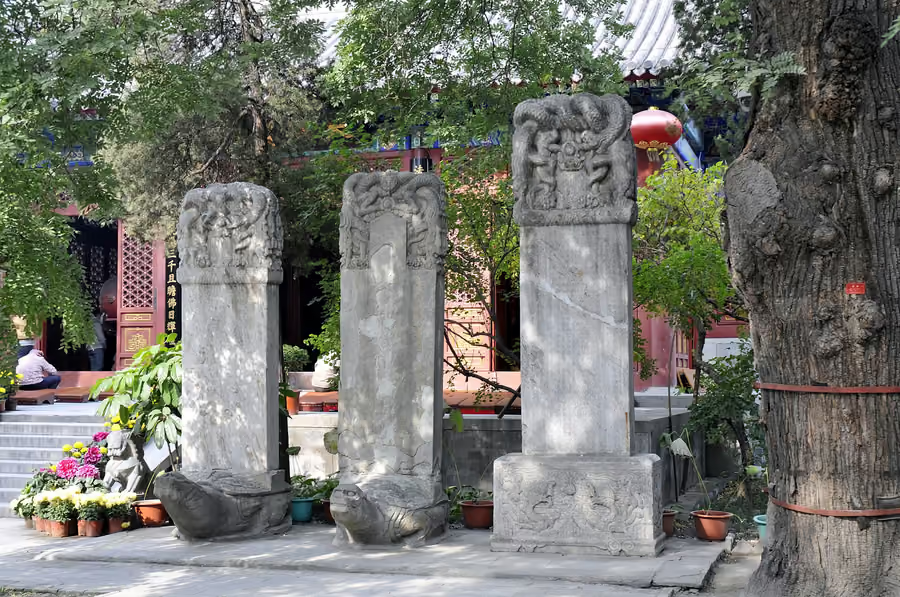
Founded in 645 by Li Shimin, the Tang emperor Taizong, as the Minzhong Temple, in memory of soldiers killed in his campaign against Goguryeo - which makes it one of the oldest foundations in Beijing, predating the imperial city by centuries. It was rebuilt in the Zhengtong era of the Ming, the infobox date being 1437, and occupies about 6,700m² in the south-west of the central city. The buildings sit symmetrically on a central axis: temple gate, Heavenly King Hall, Main Hall, Hall of Great Compassion, sutra hall, and bell and drum towers. The collection includes ancient bronzes, stone lions, gilded Buddha figures, Ming and Qing Buddhist texts, and in the Hall of Great Compassion pottery Buddhas of the Eastern Han and Eastern Wu, a Tang stone Buddha and a cast-iron Guanyin. The temple is also the subject of a novel by the Taiwanese writer Li Ao, about the failure of the 1898 reforms.
What you’ll discover
A compact, well-kept sequence of courtyards and modest halls under old trees, with no souvenir trade and very few visitors. It functions as a seminary as well as a temple, so the people in the courtyards are mostly students and monks. The reason to go in is the sculpture: the Hall of Great Compassion is effectively a small museum of Buddhist figures spanning from the Han to the Qing, which is a longer range than any other temple in the city shows.
A little local insight
Good to know before you go
- Come for the sculpture in the Hall of Great Compassion rather than the architecture. Han and Eastern Wu pottery Buddhas and a Tang stone Buddha in a working temple courtyard is not something the famous temples offer.
- The courtyards are famous locally for their flowering trees in spring, and there has historically been a flower-viewing season here - worth asking about in April if your dates fit.
- It is a few minutes' walk from the Niujie mosque, so the two make an unusual half-day of the city's oldest Buddhist foundation and its oldest mosque in the same old quarter, with excellent Hui food in between.
- As a seminary, it has working rhythms - come mid-morning, keep quiet, don't photograph students, and don't expect the halls to be staffed for visitors.
- There is almost no English signage and no audio guide; this is a site for someone who already cares about Chinese Buddhist sculpture.
- Hours here are shorter and less predictable than at the ticketed sights, and it closes some days - check before making a special trip across town.
When to come
Mid-morning on a weekday, in April for the flowering courtyards. The halls are unheated, so winter is cold; the old trees make it one of the shadier temple courtyards in summer.
Getting around
A small, level site, so distances are short and the courtyards are navigable on flat stone paving. As everywhere, each hall sits on a platform up a few steps with a raised timber threshold, and there are no ramps, lifts or accessible toilets, nor staff accustomed to helping. Good for a bad knee because of how little walking is involved; a wheelchair user will see the courtyards but need help into the halls.
Worth knowing before you go
Chinese sources agree on free, no-reservation entry but differ on the closing day and exact hours, so treat the schedule as unconfirmed and arrive mid-morning. Visitors are each given three sticks of incense at the gate; the lilacs peak in the first half of April.
Compare established providers
Check live tours and tickets
Search for Fayuan Temple in Beijing. Prices, availability, payment and confirmation are handled by the booking provider.
China Travel Select does not take payment or create the reservation. Confirm the exact name, dates, inclusions and cancellation rules on the provider’s page.
Take a closer look
Maps, videos & more
Prices and hours change. These are the places to check on the day.