Discover Dali
Three Pagodas of Chongsheng Temple
崇圣寺三塔
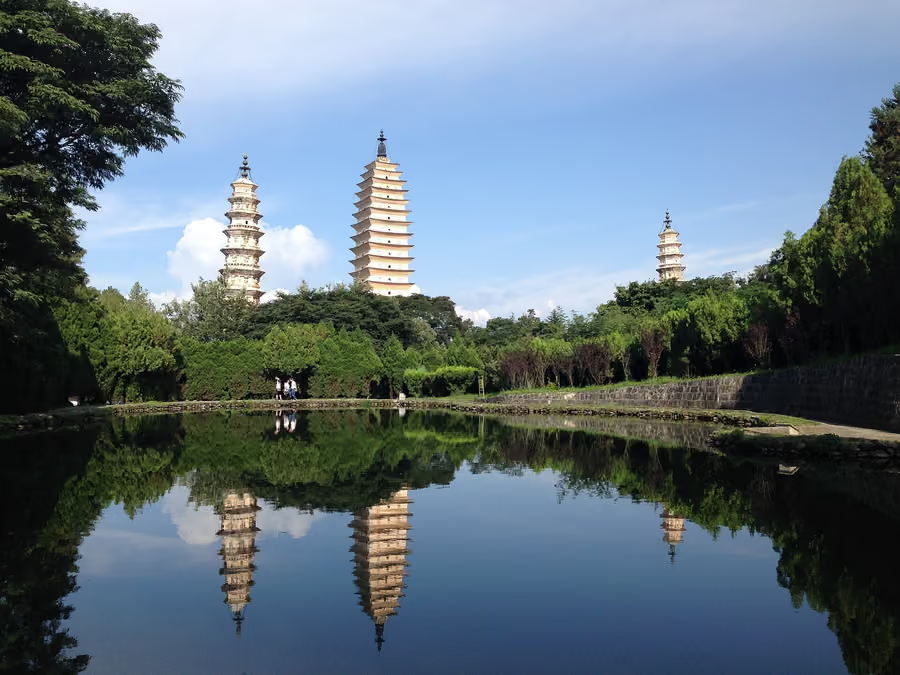
Three brick pagodas, the tallest from the 9th century Nanzhao kingdom, standing in front of a vast rebuilt temple complex with Cangshan behind. The reflecting pool shot of all three against the mountains is Dali's signature image.
The story
What makes this place special
The three brick pagodas stood outside the gate of Chongsheng Temple, the great monastery of the Nanzhao and Dali kingdoms. The central Qianxun Pagoda is a square, close-eaved brick tower of sixteen tiers of eaves, 69.13m tall; its construction date is disputed, with sources giving dates from the 7th to the 9th century, and an inscription dated 889 was found on its fourteenth storey during work in 1984. The two smaller flanking pagodas are later and are generally placed between the Tang and the Yuan. An earthquake in 1514 damaged all three and they were repaired in the Jiajing era under Li Yuanyang. The State Administration of Cultural Heritage funded a major restoration from 1978, largely finished in 1981, during which 567 objects were recovered from the base of Qianxun Pagoda's central mast and 133 statues from its top. The temple itself had long ceased to exist; the enormous complex behind the pagodas is a modern rebuilding.
What you’ll discover
Three brick towers in a triangle on a terrace at the foot of Cangshan, with a reflecting pool below them that produces the standard photograph. Behind them the ground rises steeply through a very large, entirely new temple complex of halls on successive terraces, ending at a hall of a thousand Buddhas near the top, with a view back over the pagodas to Erhai. The pagodas cannot be entered.
A little local insight
Good to know before you go
- The pagodas are the thousand-year-old part; everything uphill behind them was built in the 2000s. Many visitors climb the whole complex thinking it is ancient. If your interest is history, give the pagodas and the small museum of the 1978 finds your time and treat the rest as a park.
- The reflection pool shot works in the morning, with the light from the east and the water still.
- The climb through the new complex is long and continuous and gains well over a hundred metres. A shuttle runs up the hill from near the entrance; take it up and walk down.
- It is a 20-minute walk or a short ride from the old town's west side, and can be combined with the Cangshan Gantong cableway, which starts from the same side of the valley.
- Avoid midday. The terraces are open stone with almost no shade and the altitude makes the sun harsher than the temperature suggests.
When to come
Early morning for the pool reflection and cool air on the climb. October to April for clear views of Cangshan and the lake; summer afternoons are hot and often cloudy.
Getting around
The pagoda terrace and the reflecting pool, which is the main sight, are reached on broadly level paved ground from the entrance and are feasible in a wheelchair. The temple complex behind is a long stepped ascent of many flights with no lift; the internal shuttle covers part of the hill but the halls themselves are entered up steps. A bad knee can do the pagodas and should use the shuttle for anything higher.
Worth knowing before you go
The temple complex behind the pagodas climbs a long way uphill — the ¥98 buggy add-on is worth it if you want to see the upper halls, and the famous reflection pool sits just inside the entrance before the climb.
Compare established providers
Check live tours and tickets
Search for Three Pagodas of Chongsheng Temple in Dali. Prices, availability, payment and confirmation are handled by the booking provider.
China Travel Select does not take payment or create the reservation. Confirm the exact name, dates, inclusions and cancellation rules on the provider’s page.
Take a closer look
Maps, videos & more
Prices and hours change. These are the places to check on the day.