Discover Hangzhou
Hu Xueyan's Former Residence
胡雪岩故居
The 1872 mansion of the Qing dynasty's most famous merchant-banker, a dense warren of carved halls, a rockery garden and imported stained glass. One of the best-preserved merchant houses in China and oddly quiet given it sits ten minutes from Hefang Street.
The story
What makes this place special
Hu Xueyan was the most famous businessman of the late Qing - a banker and silk trader with an official rank, the archetype of the 'red-topped merchant' - and he built this house on Yuanbao Street from 1872, taking three years to finish it in 1875. It covers around 10.8 mu, with thirteen separate buildings and a garden called Zhiyuan whose artificial rockery contains what is described as the largest man-made limestone grotto surviving in China. Hu went bankrupt spectacularly and the house was lost; from the 1950s it was occupied by a school and a factory and more than 130 families lived in it, and it decayed badly. The Hangzhou government decided to restore it in early 1999 at a cost of 55 million yuan, working from a 1920 survey drawing of the house made by the Hangzhou-born, Italian-trained architect Shen Liyuan.
What you’ll discover
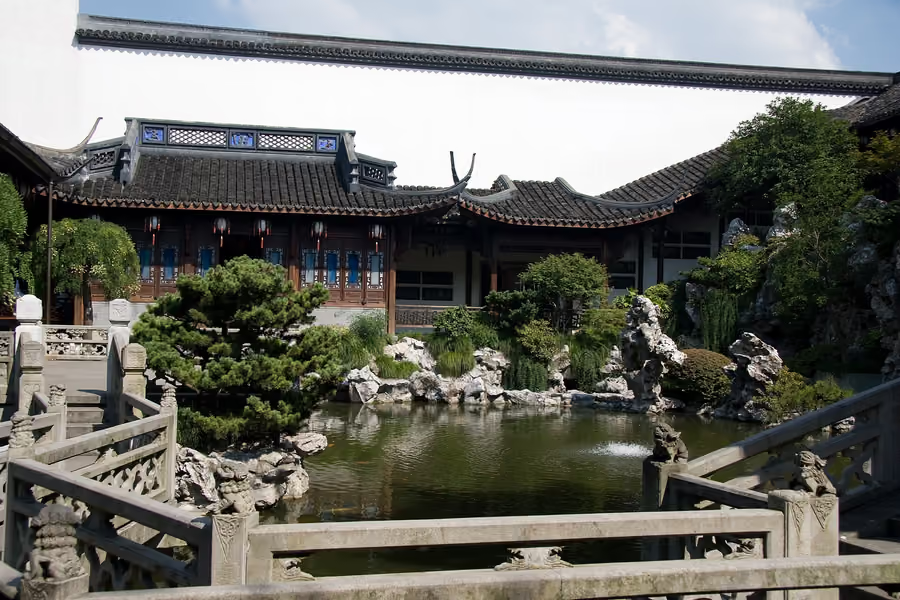
A dense warren of courtyards, halls, reception rooms and timber-galleried buildings packed into a single block behind a plain street wall, with the materials - imported glass, carved hardwood, mirrored panels, iron railings - deliberately showing off a nineteenth-century merchant's money in a way a scholar's house never would. The Zhiyuan garden at the back is built around the big artificial grotto, with a pond, a hall for performances and covered walks above the rockwork. There is also an exhibition on Hu's life and collapse.
A little local insight
Good to know before you go
- Read this as the opposite of a Suzhou garden. Those were built by scholar-officials signalling restraint; this was built by a trader signalling wealth, and the vulgarity is the historical interest. Visitors who come expecting Jiangnan understatement misread it.
- Go into the grotto. The rockery cave in Zhiyuan is the largest of its kind left in China and people walk round it on the upper path without going underneath.
- It is almost always quiet. This is one of Hangzhou's best sights by content and one of its least visited, because it is in the city rather than on the lake.
- Night opening has been introduced in recent years, with the halls lit - worth checking whether it is running, as the building is more atmospheric after dark.
- Advance booking has applied, and the house is in the old Qinghefang area near the Southern Song Deshou Palace museum, which makes a good non-lake half day in the city.
When to come
Any time; it is enclosed and roofed and works in rain or heat. Weekday mornings are emptiest, and the evening opening, if running, is the best version.
Getting around
Poor. This is a dense nineteenth-century timber house: high stone and wooden thresholds at every doorway, steps between courtyards at different levels, narrow passages, and upper galleries reached only by steep stairs. The rockery grotto is uneven, dark and stepped. A wheelchair user can see the front courtyards at best; with a bad knee it is manageable but involves constant stepping over sills.
Worth knowing before you go
Pair it with Hu Qingyu Tang, the pharmacy he founded, which is still trading on Hefang Street and has a small free museum. Hire the audio guide - without it the rooms blur together.
Compare established providers
Check live tours and tickets
Search for Hu Xueyan's Former Residence in Hangzhou. Prices, availability, payment and confirmation are handled by the booking provider.
China Travel Select does not take payment or create the reservation. Confirm the exact name, dates, inclusions and cancellation rules on the provider’s page.
Take a closer look
Maps, videos & more
Prices and hours change. These are the places to check on the day.