Discover Inner Mongolia
Mausoleum of Genghis Khan
成吉思汗陵
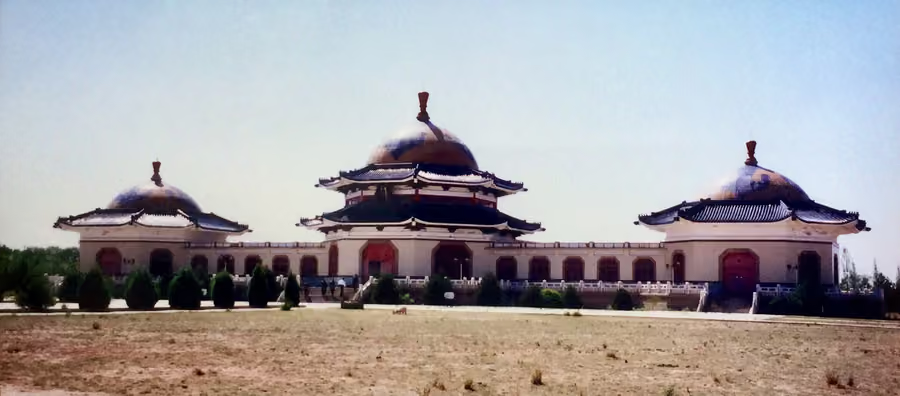
Not a grave - nobody knows where Genghis Khan is buried - but the principal shrine to him, where the Darkhad guardian clans have kept the sacrificial rites going for centuries. The 1950s-era domed halls hold relics and a large statue, and the ceremonies here are the living centre of Mongol veneration of the Khan.
The story
What makes this place special
The mausoleum is in Ejin Horo Banner, Ordos, listed as a national key cultural heritage site in 1982 and opened to the public in 1985. Its real subject is the Eight White Chambers, the portable shrines through which Genghis Khan has been honoured since the Mongol period, which were kept in Yuan-dynasty Beijing, then in the Ordos, and settled at Ejin Horo under the Qing. In 1939, during the war with Japan, the shrine was moved west to Xinglong Mountain in Gansu, and in 1949 to Kumbum monastery in Qinghai; it returned to Ejin Horo in 1954 and the present buildings were completed in 1955-1956. The complex has an octagonal main hall with a large white marble statue, a sanctuary holding memorial tents for Genghis Khan and his wives, and east and west halls with murals and objects. Where he is actually buried is unknown: the Yuan History places it at Qilian Valley, a location that has not been identified, and candidate sites include Liupan Mountain and the Altai; some scholars treat the mausoleum as a cenotaph, while the local government maintains he is buried there. The rituals are performed by Darhad guardians, with separate rites for the shrine and for the sacred standards.
What you’ll discover
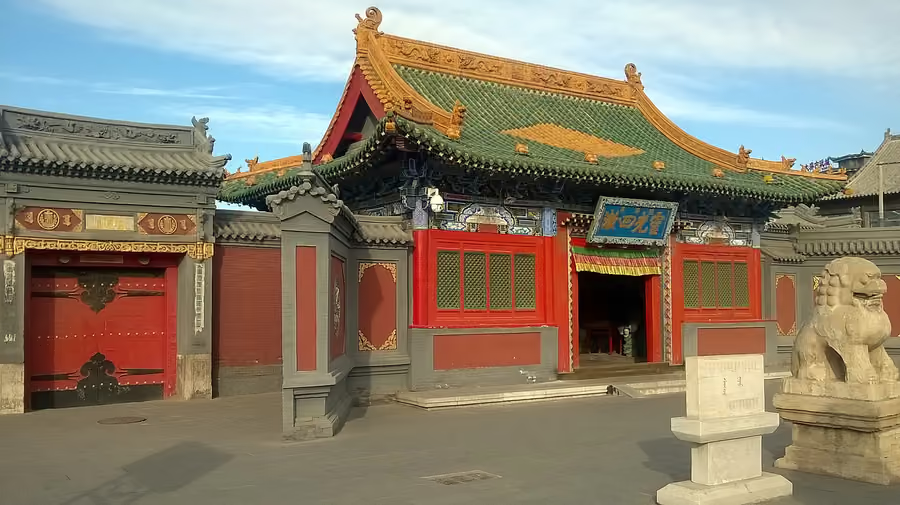
A very large ceremonial park on open ground, with a long processional approach, a bronze equestrian statue and plazas, leading up to the 1950s mausoleum building: three linked halls under Mongol-style roofs, with the marble statue in the octagonal hall and, behind it, the felt memorial tents that are the actual object of veneration, attended by Darhad custodians. Side halls carry murals of the conquests. Around the core are newer visitor attractions, museums and performance areas added since the 2000s.
A little local insight
Good to know before you go
- Understand what you are visiting. This is a shrine, not a grave: the burial site is unknown and unlocated, and what is venerated here are the memorial tents and standards, moved repeatedly across four centuries and taken to Gansu and Qinghai for safekeeping during the war. Nothing on site puts it that plainly.
- The thing worth seeing is the ritual, not the architecture. Ceremonies conducted by the hereditary Darhad guardians happen on fixed days of the lunar calendar, four main ones a year, and seeing one turns the visit from a monument into something living. Ask when booking.
- The site is very large and the walk from gate to mausoleum is long and fully exposed. Use the internal shuttle rather than walking it in July or in a March wind.
- It is around 100km from Ordos city and far from Hohhot, roughly six hours by road or a flight plus a drive. It is a day of its own, not an add-on, and the sensible pairing is with the Ordos grassland or Xiangshawan.
- Do not photograph inside the sanctuary without permission. The tents are an active object of worship attended by custodians, and the rules are stricter than at the museums.
When to come
Late spring to early autumn, May to September, for weather on an exposed site. Best of all on one of the four annual lunar-calendar ceremonial days, when the Darhad rites are performed. Winter here is extremely cold and the approach is unsheltered.
Getting around
Reasonably good. It is a 1950s and 2000s ceremonial complex with wide paved plazas, ramps on much of the approach and an internal shuttle, so a wheelchair user can reach the mausoleum area. The main halls are entered up flights of ceremonial steps, which is the obstacle; ask staff about a side approach. A bad knee should use the shuttle and take the steps slowly.
Worth knowing before you go
There are two separately ticketed sites with confusingly similar names - the historic mausoleum (成吉思汗陵) and the newer Donglian theme park next door. Make sure your driver takes you to the former.
Compare established providers
Check live tours and tickets
Search for Mausoleum of Genghis Khan in Inner Mongolia. Prices, availability, payment and confirmation are handled by the booking provider.
China Travel Select does not take payment or create the reservation. Confirm the exact name, dates, inclusions and cancellation rules on the provider’s page.
Take a closer look
Maps, videos & more
Prices and hours change. These are the places to check on the day.