Discover Suzhou
Hanshan Temple (Cold Mountain Temple)
寒山寺
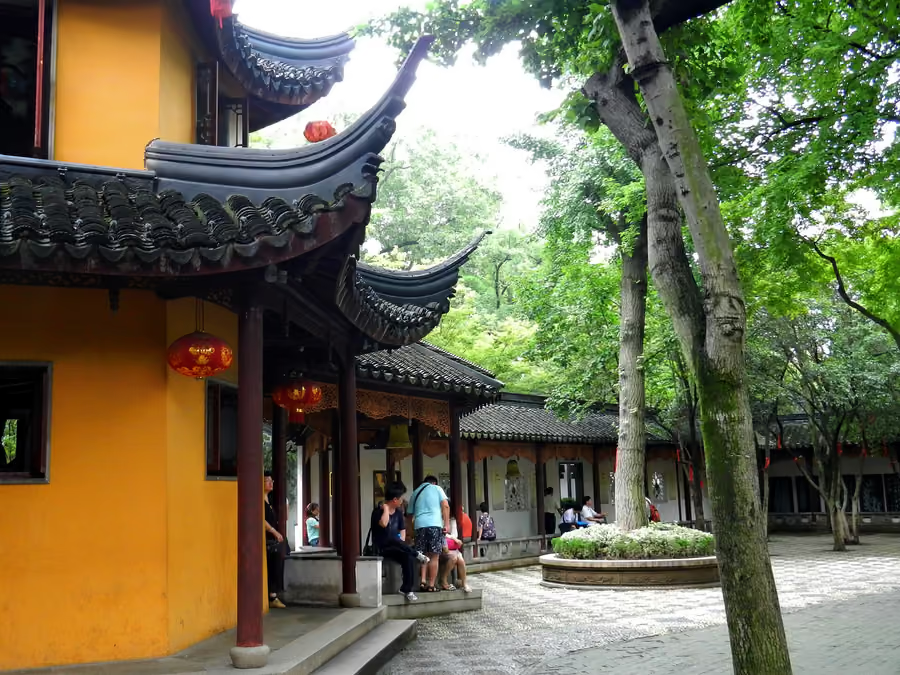
A working Buddhist temple that every educated Chinese person knows from a four-line Tang poem about hearing its midnight bell from a moored boat. The yellow walls and the bell tower beside Maple Bridge are the images that poem created.
The story
What makes this place special
The temple at Fengqiao, about 5km west of the old city, is traditionally dated to the Tianjian era of Emperor Wu of Liang, between 502 and 519, when it was called Miaoli Puming Temple. It took its present name from Hanshan, the poet-monk who with his disciple Shide is said to have come here under Tang Taizong and become abbot. Its fame across East Asia rests on a single short Tang poem, Zhang Ji's 'A Night Mooring by Maple Bridge', in which a sleepless traveller hears this temple's bell at midnight - a poem every Chinese, Japanese and Korean schoolchild learns. Two late-Qing bells are used today, one cast in China in 1906 and one in Japan; the belief that the original Tang bell was taken to Japan has been a nationalist sore point, and a new 108-tonne bell engraved with the Lotus Sutra was completed in 2007.
What you’ll discover
A compact working temple of yellow walls and dark tiled roofs, with the main halls, the stele hall holding carved versions of Zhang Ji's poem by famous calligraphers, the bell tower where visitors queue to strike the bell three times, and a modern pagoda added in the 1990s that you can climb for a view over the compound and the Grand Canal. Outside the walls is the Fengqiao scenic area with the humpbacked Maple Bridge, the old canal wharf and a statue of Zhang Ji.
A little local insight
Good to know before you go
- Read the poem first, in any decent translation, and the temple goes from ordinary to moving. Without it this is a mid-sized temple a long bus ride from the old town.
- Striking the bell is a paid add-on and is traditionally three strikes. The queue forms at the tower and moves fast; this is what most Chinese visitors come to do.
- The stele gallery is the connoisseur's part - the same twenty-eight-character poem carved repeatedly by different hands across centuries - and the tour groups walk straight through it.
- Go out of the gate to Maple Bridge and the canal. The poem is about the view from a boat on the water, not from inside the temple, and the bridge and the wharf are a two-minute walk that most visitors skip.
- New Year's Eve here is a major East Asian pilgrimage: the bell is rung 108 times at midnight and Japanese and Korean visitors come specifically for it. Magnificent if that is what you want, impossible if it is not.
When to come
Early morning on a weekday, when it is a functioning temple with monks and incense rather than a bell queue. Autumn is the season of the poem and of maple colour by the bridge. Chinese New Year's Eve for the 108 strokes, if you can handle the crowd.
Getting around
Moderate. The temple is largely a flat walled compound of courtyards on one level with paved surfaces, so getting round it in a wheelchair is feasible, but each hall has raised stone thresholds and a step or two up, and the bell tower and the pagoda are both reached by stairs with no alternative. Maple Bridge outside is a stepped stone humpback bridge. A bad knee is fine; a wheelchair user will see the courtyards and halls from the doorways.
Worth knowing before you go
On New Year's Eve the temple holds a famous bell-striking ceremony - 108 strikes at midnight - and tickets for that night are sold separately and far in advance.
Compare established providers
Check live tours and tickets
Search for Hanshan Temple (Cold Mountain Temple) in Suzhou. Prices, availability, payment and confirmation are handled by the booking provider.
China Travel Select does not take payment or create the reservation. Confirm the exact name, dates, inclusions and cancellation rules on the provider’s page.
Take a closer look
Maps, videos & more
Prices and hours change. These are the places to check on the day.