Discover Suzhou
Suzhou Museum
苏州博物馆
I. M. Pei's late-career masterpiece, a white-and-grey building that reinterprets Suzhou's garden architecture in modern geometry, holding Wu-kingdom bronzes, Ming paintings and a famous Buddhist reliquary. The building is as much the exhibit as the collection.
The story
What makes this place special
The museum was founded in 1960 in the former residence of Li Xiucheng, the Taiping general known as the Zhong Wang, and that mansion is still part of it. The building everyone comes for is the new wing by I. M. Pei, begun in 2002 and opened on 6 October 2006 - Pei's family came from Suzhou, and his ancestors owned the Lion Grove Garden a few minutes' walk away, so the building is a local architect's late return to his own city. It holds around 30,000 objects plus some 70,000 books and documents.
What you’ll discover
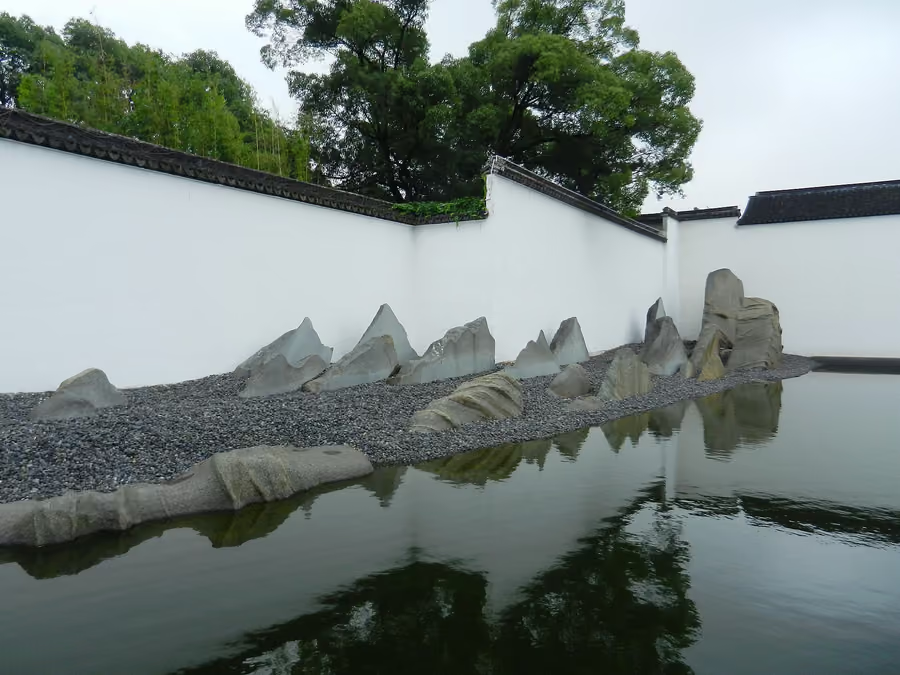
Pei's building is itself the main exhibit: white stucco walls with dark grey stone edging in the colours of old Suzhou, but resolved into octagons, rhombuses and triangles, with a glass-and-steel roof that casts shifting geometric shadows, metal louvres controlling the light, and an octagonal top-lit atrium. The main courtyard behind it is a modern reading of a Suzhou garden - a wall of cut rock slices standing in water as an abstracted mountain range, a bridge, bamboo and an octagonal pavilion. Inside, the permanent galleries cover Wu-state archaeology, the pagoda treasures recovered from Suzhou's Buddhist towers, Suzhou crafts, and Ming and Qing painting and calligraphy of the Wu school. The old Zhong Wang mansion adjoins it.
A little local insight
Good to know before you go
- Book ahead. Entry is free but capacity-limited and the museum has run on advance online reservation for years - turning up at the door is the standard way foreign visitors lose a morning here.
- Look at the building before the collections. The sight lines are composed: stand in the atrium looking out at the rock wall across the water, and look up at the roof lattice shadows. These are the things the architecture is for.
- The pagoda relics are the collection's real treasures - objects sealed inside Suzhou's temple pagodas and recovered in the twentieth century, including exquisite small-scale shrines and reliquaries. They are easy to rush past.
- Do not miss the Zhong Wang mansion next door; it is included and most visitors never realise the old section exists.
- Do this, the Humble Administrator's Garden and the Lion Grove in one morning - all three are on the same street, and seeing Pei's building after the garden his family restored is the point of the sequence.
When to come
First thing on a weekday, both for the booking slots and because the atrium light is best in the morning. Closed on Mondays in common with most Chinese museums - check before planning around it.
Getting around
Excellent, and the best-equipped sight in Suzhou. The new wing is a modern museum with lifts, ramps, level floors and accessible toilets, and the courtyard paths are paved and smooth. The old Zhong Wang mansion is a historic building with raised thresholds and some steps and is harder. A wheelchair user can do the whole new museum unaided.
Worth knowing before you go
Slots open at a fixed hour each day; set an alarm. Bring your actual passport - the booking is tied to the document number and staff check it at the door.
Compare established providers
Check live tours and tickets
Search for Suzhou Museum in Suzhou. Prices, availability, payment and confirmation are handled by the booking provider.
China Travel Select does not take payment or create the reservation. Confirm the exact name, dates, inclusions and cancellation rules on the provider’s page.
Take a closer look
Maps, videos & more
Prices and hours change. These are the places to check on the day.