Discover Suzhou
Suzhou Silk Museum
苏州丝绸博物馆
A free museum tracing 4,000 years of Chinese silk, with a live mulberry-and-silkworm room and working antique looms weaving reproduction court brocades. Suzhou was the imperial silk workshop, and this explains why.
The story
What makes this place special
Established in 1989 and opened in 1991 beside the North Temple Pagoda on Renmin Road, this was the first museum in China devoted specifically to silk, and it was refurbished in 2016. It covers 9,500 square metres with 4,000 square metres of display, and was promoted to national first-grade museum status in 2024. The subject is local: Suzhou's song jin brocade is traced back to the Spring and Autumn period, a state weaving office was set up in the city under the Southern Song, and the technique reached its height under Kangxi and Qianlong.
What you’ll discover
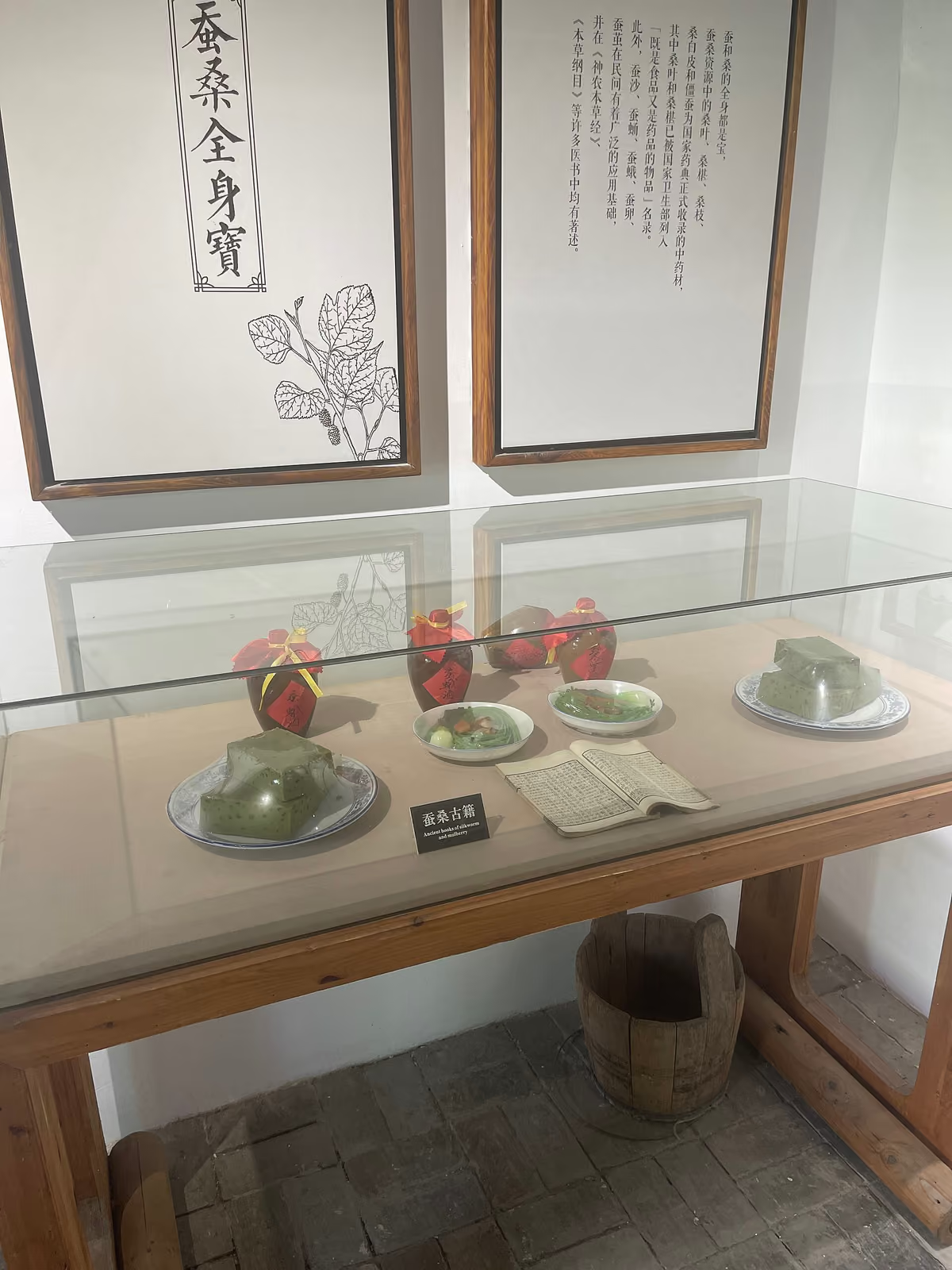
Six display areas: a history hall, a modern hall, a children's science section, a mulberry courtyard, a gallery of silk-weaving machinery, and a hall devoted to the textile artist Qian Xiaoping. The history hall is the substantial one and is divided into an ancient gallery that walks the chronology with reproductions of Warring States, Han and Tang silks and original fragments from the Tang, Liao, Song and Yuan, plus Tang, Ming and Qing costume; then a sericulture room, a weaving and dyeing workshop where song jin and zhang duan velvet are woven live on traditional looms, a tribute-weaving office reconstruction, a Republican-era street, and an intangible-heritage hall of song jin, Suzhou embroidery and velvet work.
A little local insight
Good to know before you go
- The live weaving in the dyeing and weaving workshop is the reason to come. Song jin brocade on a draw loom needs two people working together and is extraordinarily slow; seeing a few centimetres produced explains why this fabric was a tribute good.
- Look at the mulberry courtyard and the silkworms if the season is right - the full chain from leaf to cloth in one building is something no other museum in Suzhou shows.
- It is free, and it follows the usual Chinese state museum pattern of a weekly closing day and an entry cut-off well before closing - so do not leave it to the end of the afternoon.
- It is beside the North Temple Pagoda and on metro line 4 at Beisita station, which makes it an easy addition to a northern old-city morning with the pagoda and the Humble Administrator's Garden.
- Do not confuse it with the China National Silk Museum in Hangzhou, which is larger and covers the whole country - this one is specifically about Suzhou's own weaving and about song jin.
When to come
Any day it is open; indoors, so a good wet-weather or hot-afternoon option. Weekday mornings are quietest and the weaving demonstrations are more likely to be staffed.
Getting around
Good. A purpose-built and recently refurbished museum with level galleries, lifts and ramped access, and the metro station nearby has lifts. Fully usable in a wheelchair. The Republican-street reconstruction has some uneven paving by design.
Worth knowing before you go
Go to the weaving hall at the back - staff operate the huge two-person drawloom, and watching one brocade being made at a few centimetres a day explains the historical price of silk better than any label.
Compare established providers
Check live tours and tickets
Search for Suzhou Silk Museum in Suzhou. Prices, availability, payment and confirmation are handled by the booking provider.
China Travel Select does not take payment or create the reservation. Confirm the exact name, dates, inclusions and cancellation rules on the provider’s page.
Take a closer look
Maps, videos & more
Prices and hours change. These are the places to check on the day.