Discover Xinjiang
Jiaohe Ruins
交河故城
A 2,000-year-old city carved downwards into a loess plateau between two rivers, abandoned after the Mongol wars and preserved by the desert climate. You walk the original sunken streets past temple foundations and a stupa grove - one of the best-preserved earthen cities anywhere, and a UNESCO Silk Road World Heritage site.
The story
What makes this place special
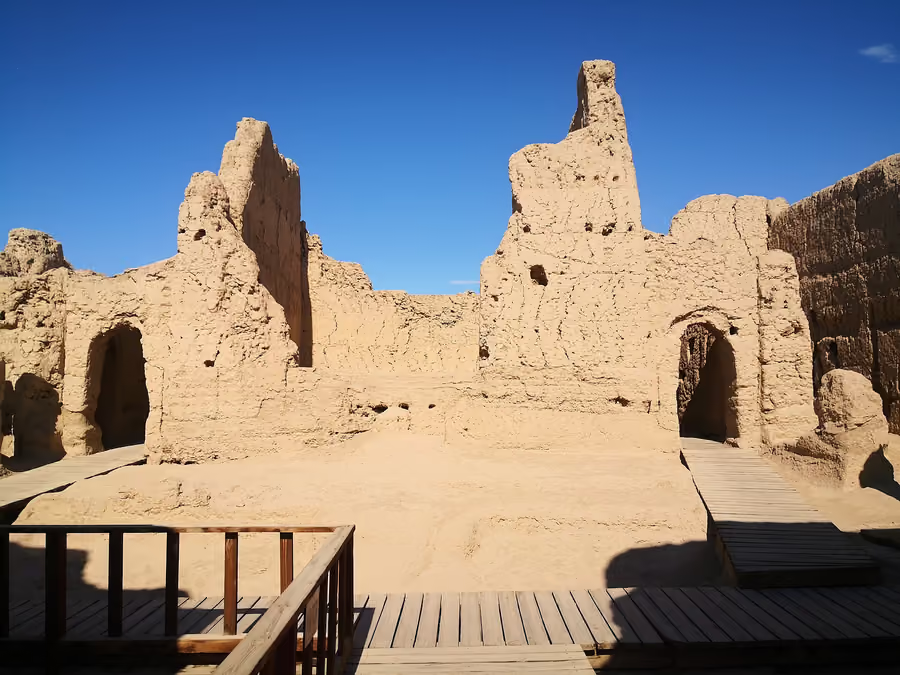
Jiaohe, about 10km west of Turpan, was the capital of the Anterior Jushi kingdom from 108 BC to AD 450 and remained in use for centuries afterwards. It occupies a loess islet between two river valleys, about 1,650m long and up to 300m wide, with cliffs over 30m high that served as its defences, so it has no walls. Its most striking quality is that it was largely cut down into the loess rather than built up: Aurel Stein described a maze of ruined dwellings and shrines carved for the most part out of the loess soil. A Buddhist quarter of temples and stupas occupies the northern end. The city was destroyed during the Mongol invasions of the thirteenth century and abandoned. The site, given as 680.33 hectares, was inscribed in 2014 as part of the Silk Roads: Chang'an-Tianshan Corridor World Heritage listing.
What you’ll discover
You cross onto the islet and walk a main avenue sunk below ground level between walls of excavated loess, with doorways, stairs, wells, cellars and whole rooms cut into the material on either side, roofless and the colour of dust. The southern end is residential and administrative; the northern end holds a large central stupa surrounded by a grid of 100 small stupa bases, which is the single most memorable thing on the site. There is no shade anywhere and the whole city is a single colour.
A little local insight
Good to know before you go
- Go at opening or in the last two hours. Turpan is one of the hottest inhabited places in China, the site has effectively no shade, and a midday visit in July is genuinely dangerous as well as unpleasant.
- Walk to the far northern end for the stupa field. It is about a kilometre from the entrance, the group tours usually turn back before it, and it is the best-preserved and strangest part of the site.
- Understand the construction before you look at it. This is a city subtracted from the ground rather than added to it, which is why the walls have no joints and the doorways have no lintels; once you see that, the whole site reads differently.
- Nothing portable is left here. The manuscripts, paintings and grave goods are in the regional museum in Urumqi and in collections abroad, so see the museum first if you can.
- Take more water than you think, a hat and sunglasses. The loess reflects heat and glare, and there is nowhere on the islet to buy anything.
- Jiaohe, Gaochang, the Flaming Mountains, Bezeklik and the karez are all within a short drive of Turpan and are normally done as one circuit by hired car; Jiaohe is the better preserved of the two cities and the one to do if you only do one.
When to come
Early morning or the last hours before closing, in April to early June or September to October. Avoid midday and avoid July and August altogether if you can; Turpan regularly exceeds 40C.
Getting around
Limited. The main avenue is compacted earth and broadly level in stretches, and a wheelchair can manage some of the central route with a strong companion, but surfaces are rutted and sandy, there are steps and ramps cut into the loess at many junctions, and the far northern stupa field is a kilometre away over rough ground. Shade and seating are effectively absent. A bad knee can do a shortened out-and-back; the heat is the real barrier.
Worth knowing before you go
There is almost no shade on the plateau and Turpan is the hottest place in China - go at opening or late afternoon, and carry more water than you think you need.
Compare established providers
Check live tours and tickets
Search for Jiaohe Ruins in Xinjiang. Prices, availability, payment and confirmation are handled by the booking provider.
China Travel Select does not take payment or create the reservation. Confirm the exact name, dates, inclusions and cancellation rules on the provider’s page.
Take a closer look
Maps, videos & more
Prices and hours change. These are the places to check on the day.