Discover Lhasa
Sera Monastery
色拉寺
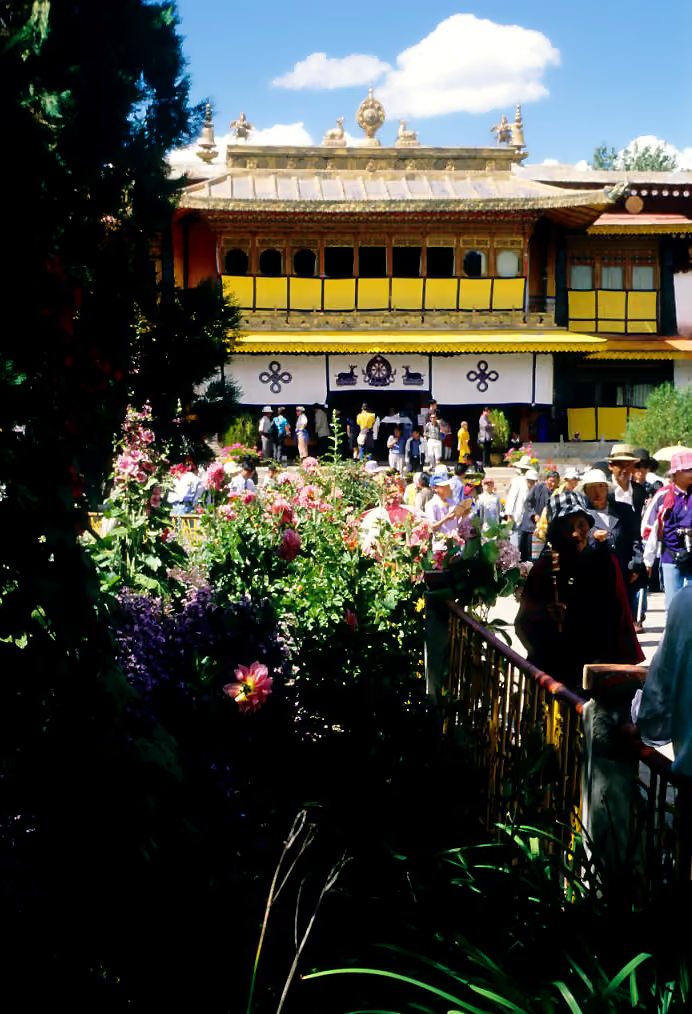
One of the three great Gelugpa monasteries of Lhasa, founded in 1419 beneath a rocky hillside. Its draw is the afternoon debating courtyard, where monks argue scripture with theatrical hand-claps and stamps under the poplar trees.
The story
What makes this place special
Sera, the Wild Roses Monastery, was founded in 1419 by Jamchen Chojey Sakya Yeshe, a disciple of Tsongkhapa, at the foot of Pubuchok hill about 2km north of Lhasa. It is one of the three great Gelug university monasteries along with Ganden and Drepung. The complex is built around the Great Assembly Hall, the Tsokchen, and three colleges: Sera Je and Sera Me, which took monks through a philosophical programme of roughly twenty years to the geshe degree, and Ngakpa, which concentrated on tantric ritual. It housed around 6,000 monks over its history, with Sera Je alone recording 5,629 in 1959 before the bombardment that killed hundreds; the exile community re-established itself at Bylakuppe in India. Nineteen hermitages are affiliated to Sera in the hills to the north, including four nunneries, the largest being Pabongkha, with Sera Utsé on the mountain directly behind.
What you’ll discover
A hillside town of whitewashed buildings, flagstoned lanes and chapels rather than a single temple, so the visit is a walk between courtyards. The draw is the debating courtyard, a gravelled yard under trees where monks sit in pairs and groups and argue points of logic, driving home each challenge with a hard clap and a sweep of the arm, on a fixed daily schedule. Inside, the Great Assembly Hall holds a large Maitreya image and a set of the Kangyur scriptures, and the colleges have their own protector chapels, one of which is heavily visited by local worshippers bringing offerings for children.
A little local insight
Good to know before you go
- Time the visit around the debates, which run to a set daily schedule, normally in the afternoon. Arriving at the wrong hour means an empty courtyard and a lot of walking; the debate is the reason to come.
- Watch quietly from the side and do not use flash or push into the groups. The debates are real teaching sessions, not a show, and photography rules vary by courtyard.
- Do the kora, the walking circuit behind the monastery, if you have time and acclimatisation. It climbs the hillside past rock paintings and hermitages, with the whole Lhasa valley below, and almost no visitors do it.
- Sera and Drepung are both large hillside monasteries with similar material. If you only do one, Sera is the better choice for the debates and the shorter approach; Drepung for scale and the walk.
- It is a short taxi or bus ride from central Lhasa, which makes it an easy afternoon and a good second-day activity while still acclimatising, as the main courtyards are on relatively level ground.
- Bring small notes. Chapel offerings are made in one-yuan notes and there is nowhere to change money up here.
When to come
Afternoon, for the debating session, on a weekday when the schedule is normal. April to October for warmth; the courtyard is in the open and cold in winter afternoons. Avoid major festival days, when the monastery's own programme replaces the debates.
Getting around
Partly manageable. The lower lanes and the main courtyards, including the debating yard, are on broadly level flagstone and gravel reachable by vehicle from the gate, so a wheelchair user can see the debates with help over some uneven surfaces. The Great Assembly Hall and the college chapels are entered up steps and over raised sills, and the upper parts of the complex and the kora are steep. A bad knee can do the core on the flat.
Worth knowing before you go
Arrive by 14:30 to get a place at the courtyard rail before the debating starts, and do not photograph monks' faces up close without asking — some courtyards ban cameras outright.
Compare established providers
Check live tours and tickets
Search for Sera Monastery in Lhasa. Prices, availability, payment and confirmation are handled by the booking provider.
China Travel Select does not take payment or create the reservation. Confirm the exact name, dates, inclusions and cancellation rules on the provider’s page.
Take a closer look
Maps, videos & more
Prices and hours change. These are the places to check on the day.